Report Generation Automation Software Pricing Guide: What to Expect
Report automation pricing usually hides behind a demo request. That is a problem when you just want to know whether per-member billing will fit a 12-person field crew, or whether an annual plan saves enough to justify the commitment.
By the end of this guide, you will know the factors that drive report generation software costs, how per-member pricing compares to flat-rate plans, and what a monthly versus annual commitment actually saves. You will also see Tasks.Bot's specific pricing, the features that affect cost, and the hidden fees to check before you buy.
What Is Tasks.Bot? Report Generation Automation via WhatsApp
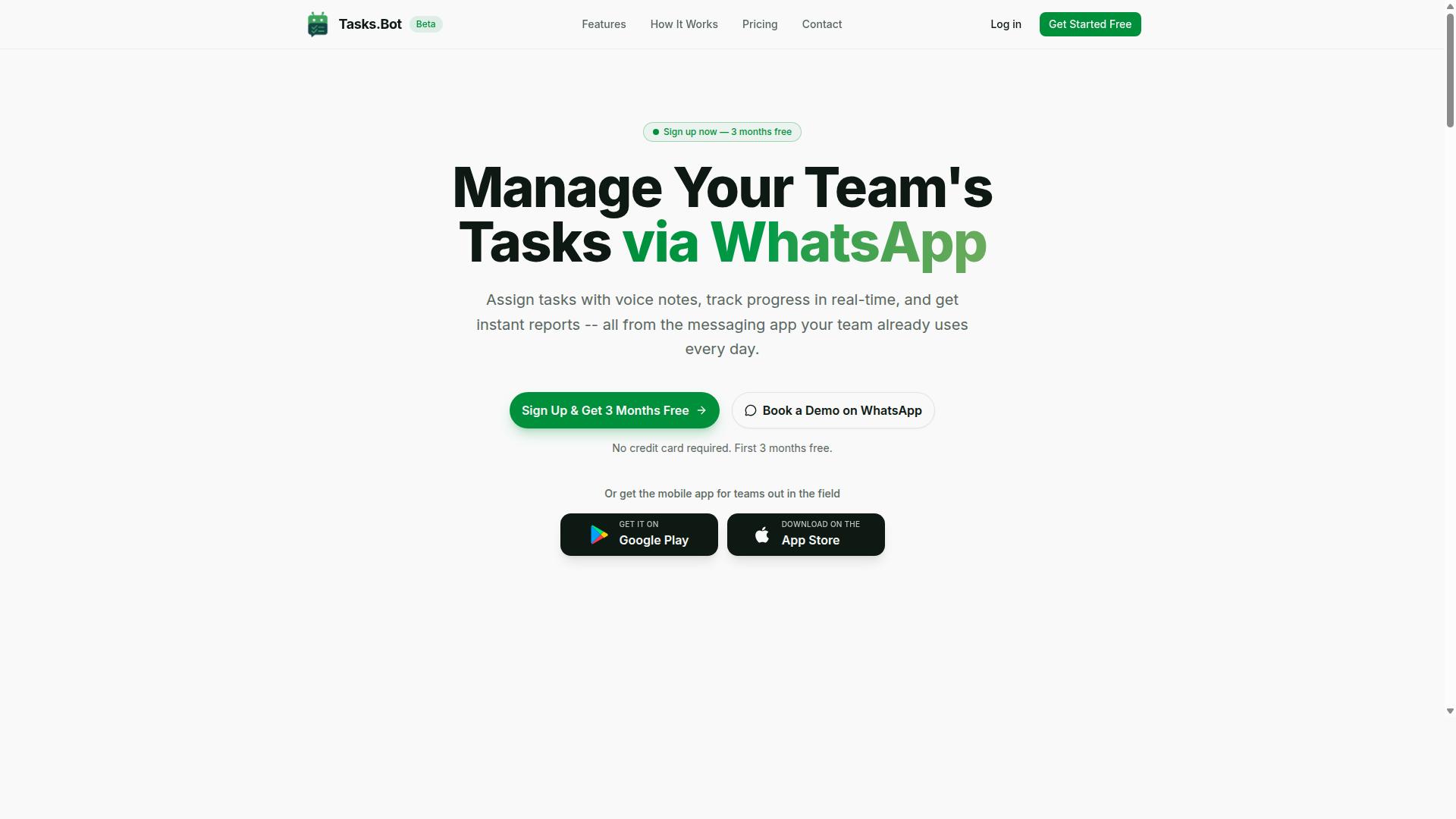
Tasks.Bot is a task management platform that runs entirely inside WhatsApp, letting teams assign tasks, track progress, and receive instant reports without leaving the chat app. Instead of asking people to learn another dashboard, it turns the messaging tool they already use every day into the place where work gets organized and reported on.
That design choice matters for anyone weighing report generation automation. Most reporting software adds a new login, a new notification stream, and a new habit to build. Tasks.Bot removes that friction by keeping task creation, assignment, and reporting in one familiar thread.
How teams actually use it comes down to a few simple actions:
- Create tasks by voice note or text inside a WhatsApp conversation
- Automatic task assignment so work reaches the right person without manual routing
- Smart deadline reminders that keep items from slipping past due dates
- Instant report generation so status updates arrive without anyone compiling a spreadsheet
The reporting side is where the platform earns its place in a pricing conversation. Reports are generated instantly from activity already captured in chat, which means no separate data entry step and no lag between work happening and work being visible. For teams that currently spend hours each week assembling updates by hand, that shift changes the real cost of reporting, not just the sticker price.
Adoption is deliberately low-friction. Team members do not need to install anything or create new accounts to take part. If someone is in the WhatsApp group, they are in the workflow. That removes the two most common reasons reporting tools fail: forgotten passwords and abandoned apps.
For teams working away from a desk, Tasks.Bot also offers a mobile app for field teams. This extends the same task and reporting flow to people who are on site, in transit, or otherwise not sitting in front of a computer.
The service is currently in beta and offers a free trial period, with hundreds of teams already using it. For buyers comparing report generation automation software, that combination is worth noting: a free trial lets you evaluate fit before committing budget, while an active beta user base suggests the platform is being tested and refined in real working conditions rather than only in a demo environment.
In short, Tasks.Bot is best understood as WhatsApp-native task management with reporting built in. It suits teams that want structured assignments and regular status reports without adding another tool to the stack. When you reach the pricing sections of this guide, keep that framing in mind: you are evaluating a platform whose main cost advantage is the workflow it replaces, not just the subscription it charges.
How Much Does Report Generation Automation Software Cost? Key Pricing Factors
Report generation automation software typically costs between $5 and $50 per user per month, depending on the pricing model and feature set. That range sounds wide because it is. A basic tool that schedules a PDF export sits at the low end, while a platform handling real-time dashboards, automated distribution, and multiple data source connectors climbs toward the top.
Understanding what drives the number up or down helps you match a subscription tier to your actual needs instead of paying for capacity you will never use. A report generation automation pricing guide is really a guide to trade-offs.
Four factors shape most quotes:
- Number of users who need to build, edit, or view reports
- Features such as AI-assisted writing, API access pricing, and template libraries
- Deployment method, whether cloud-based deployment, on-premise installation, or hybrid hosting
- Support level, from self-service documentation to dedicated account management
Feature depth is often the biggest swing factor. A drag-and-drop editor and basic Excel output may be included at every tier, while data source connectors, custom branding, and automated email delivery are frequently gated behind higher plans. Integration expenses and customization charges can appear as one-time fees on top of the subscription.
Deployment matters too. Cloud-based deployment usually bundles hosting into the subscription, while on-premise installation often carries a separate license and infrastructure cost. Support tiers add another layer, since faster response times and onboarding assistance rarely come free.
The sections below break down the two decisions that affect your bill most: how users are counted and how often you pay.
Per-Member Pricing vs. Flat-Rate Plans
Per-member pricing scales with team size, while flat-rate plans charge a fixed fee regardless of user count, making each model better suited to different team structures. Neither is universally cheaper. The right choice depends on how many people touch your reports and how fast that number is likely to grow.
Per-user licensing is predictable and easy to budget for a small team. Ten people on a $10 per member plan pay $100 per month. The catch is that the same plan costs $500 monthly at fifty users, even if only a handful of those people build reports regularly.
Flat-rate pricing flips that equation. A flat-rate plan might cost $200 per month for unlimited users, which is double the ten-person example but a fraction of the fifty-person one. Larger teams gain cost certainty and can invite viewers, approvers, and occasional contributors without watching the meter.
The trade-off is flexibility. Flat-rate plans sometimes cap data sources, scheduled reporting jobs, or storage, so "unlimited users" does not always mean unlimited everything. Before choosing, estimate two numbers:
- Your current headcount that needs access
- Where that headcount will be in twelve to twenty-four months
If you expect steady hiring, flat-rate pricing usually wins. If your team is stable and small, per-member billing keeps costs low and aligns spending with actual usage. Many vendors also offer a free trial, which lets you test how many seats you genuinely need before committing.
Monthly vs. Annual Billing: Where the Savings Are
Opting for annual billing typically saves 15 to 20% compared to paying monthly, but it requires a larger upfront commitment. Monthly plans offer flexibility and a lower entry cost, which suits teams still evaluating tools or working within tight cash flow.
The math is straightforward. If a monthly plan costs $10 per user, an annual plan might cost $100 per user, effectively giving you two months free and saving $20 per user per year. Across a twenty-person team, that difference adds up quickly.
Annual commitments also tend to come with stability. Your rate is locked for the term, which protects against mid-year price increases and makes budgeting simpler. The downside is that switching costs rise if the software turns out to be a poor fit.
Weigh three questions before signing an annual agreement:
- Can your cash flow absorb the full upfront payment?
- How confident are you in the platform after a free trial or pilot?
- Does the contract allow seat adjustments as your team changes?
If the answers are uncertain, start monthly and revisit once usage patterns are clear. If the tool has proven itself and the discount is meaningful, annual billing is usually the better financial move. Watch for implementation fees or onboarding costs that may be bundled into annual agreements, since those can shift the true first-year total.
What Tasks.Bot's Report Automation Pricing Actually Looks Like
Tasks.Bot offers a single 'Full Access' plan with all features included, priced per member in both Indian Rupees and US Dollars. There are no starter tiers, no feature gates, and no upgrade maze to navigate. That structure sets Tasks.Bot apart from the subscription tiers and per-user licensing ladders common in report generation automation software.
Two billing cycles are available. Readers can choose a monthly option or commit to a full year. The site includes a 'Select currency' toggle with options for Indian Rupee and US Dollar, so buyers should confirm the displayed currency before checkout.
It is worth noting that Tasks.Bot is currently in beta. Beta status often means early adopters get access to the complete product at the listed price while the platform continues to mature. For teams weighing cost expectations against a crowded market of freemium plans and enterprise pricing, a single transparent plan removes much of the guesswork.
The sections below break down the exact numbers for the Full Access plan and explain what onboarding looks like, including how to explore the product before committing any budget.
Full Access Plan: ₹200/Month or ₹1,200/Year per Member
Tasks.Bot's Full Access plan costs ₹200 per member per month or ₹1,200 per member per year, giving teams all features without tiered restrictions. The annual option works out to roughly ₹100 per month per member, a saving of 50%, or ₹1,200 saved per member each year.
Pricing is also shown in US Dollars for international buyers. Exchange rates shift constantly, so readers should verify the current conversion at the time of purchase rather than relying on any fixed figure.
The important detail is the word "member." This is per-user licensing, not flat-rate pricing. Total cost scales directly with team size. A simple example makes it concrete:
- A 10-member team pays ₹2,000 per month
- The same team pays ₹12,000 per year on the annual plan
- That annual figure equals ₹100 per member per month across the team
Compare that with typical usage-based billing or enterprise pricing models, where report volume, API access pricing, or data source connectors can push invoices upward unpredictably. A fixed per-member rate keeps budgeting straightforward for teams of any size, from a small analytics group to a larger reporting department.
Free Trial and No-Credit-Card Onboarding
Tasks.Bot offers a 'Book a Demo on WhatsApp' option and the service is currently in beta. New users also get 3 months free with no credit card required, and the plan can be cancelled at any time.
That combination lowers the risk considerably. Many report automation platforms bury buyers in implementation fees or onboarding costs before a single report is generated. Tasks.Bot lists no such charges. The path from interest to active use appears to be a WhatsApp demo followed by a no-card start.
Prospective buyers should still confirm a few details directly with Tasks.Bot:
- Whether trial availability differs during the beta period
- Whether beta pricing is locked in for early adopters
- How the 3-month free period applies to monthly versus annual billing
- What the refund policy in the site footer covers
Because the product is in beta, terms may evolve, and a quick conversation through the demo channel is the most reliable way to get current answers. For teams comparing free trial offers across report generation automation tools, the no-credit-card entry point and cancel-anytime terms make Tasks.Bot a genuinely low-commitment option to evaluate.
What Drives Cost: Features That Affect Report Automation Pricing
Advanced features like AI-powered task creation, real-time dashboards, and automated distribution often increase the base price of report automation software. Buyers comparing quotes quickly notice that two tools with similar sounding descriptions can land in very different price bands once the feature list is examined closely.
Most vendors build pricing around a handful of common cost drivers. Understanding them makes it easier to judge whether a quoted figure reflects real value or simply a longer list of extras.
- AI capabilities such as natural language parsing and voice input, which require ongoing model and processing costs
- Integrations with messaging platforms, calendars, and data sources, often priced as add-ons or higher tiers
- Advanced reporting including scheduled reporting, automated distribution, and export options like PDF, Excel, and CSV
- Field and workforce features such as GPS tracking and attendance verification
- Scalability, where per-user licensing and usage-based billing push costs up as teams grow
Pricing models vary just as widely. Some vendors rely on subscription tiers and per-user licensing, others on flat-rate pricing or usage-based billing, and enterprise pricing usually sits in a custom quote. Freemium plans and a free trial are common entry points, while implementation fees, onboarding costs, customization charges, and integration expenses frequently appear as separate line items.
The sections below look at the specific capabilities behind these cost drivers and how Tasks.Bot packages them.
Instant Reports, Voice Note Task Creation, and AI Automation
Tasks.Bot uses AI to understand natural language and voice notes, enabling instant report generation and automated task assignment directly within WhatsApp.
This matters because manual effort is usually the hidden cost in report automation. When someone has to retype a message into a task list or chase updates across apps, the software saves less time than promised. Tasks.Bot removes that step by working where conversations already happen.
Key capabilities in this area include:
- Voice note task creation, so a spoken message becomes a task
- AI that parses natural language to understand what the user wants
- Automatic task assignment to the right person
- Smart deadline reminders to keep work on schedule
- Approvals and automations for recurring workflows
- Instant reports generated from live task data
These features typically sit behind premium tiers in report generation automation software, where AI and automation are priced as upgrades. With Tasks.Bot, they are included in the Full Access plan at no extra charge. That single packaging decision changes the cost expectation considerably, because the capabilities that usually drive price increases are part of the standard offering rather than a paid add-on.
For buyers building a pricing guide comparison, this is the clearest differentiator. The per-member cost covers the AI layer, the automation layer, and the reporting layer together, instead of stacking them as separate fees.
Attendance, GPS Tracking, and Payroll-Ready Hours
Tasks.Bot includes attendance tracking with GPS and face verification, generating payroll-ready hours for field staff. For teams that operate outside an office, this is often the feature that decides whether a tool is worth its price at all.
Field-based businesses face a specific reporting problem. Hours worked on site, shift coverage, and attendance records are usually collected on paper or through separate apps, then reconciled manually before payroll. That reconciliation is slow and easy to get wrong.
Tasks.Bot addresses this by combining several related capabilities:
- Face-verified attendance, so check-ins confirm the person present
- Live GPS tracking for staff working in the field
- Shifts, leave, and hours management in one place
- Payroll-ready hours compiled from tracked attendance data
These capabilities carry real weight in software pricing models. Attendance verification and location tracking are frequently sold as separate modules or reserved for enterprise pricing tiers. Here they form part of the Full Access plan alongside task management and reporting.
For a business managing remote or field workers, that combination delivers significant value. The same per-member cost that covers instant reports and AI task creation also covers the attendance and hours data that feeds payroll. Instead of paying for a reporting tool plus a time-tracking tool plus a location service, the cost expectation stays in one place. That is a meaningful difference when comparing subscription tiers across report generation automation options.
Hidden Costs to Watch For in Report Automation Software
Beyond subscription fees, report automation software can incur hidden costs such as implementation fees, customization charges, and integration expenses. These add-ons often appear after a buyer has already committed to a plan, which makes them easy to overlook during the initial comparison.
A pricing guide is only useful if it accounts for the full picture. The sticker price on a pricing page rarely reflects what a team actually pays once setup, connections, and usage limits come into play. Asking the right questions before signing up is the simplest way to avoid surprises.
Below are the most common extras that push real-world cost expectations above the advertised rate.
- Implementation and onboarding costs: Vendors may charge a one-time fee to configure the platform, migrate historical data, or train staff.
- Customization charges: Building custom report templates, adjusting a drag-and-drop editor layout, or tailoring scheduled reporting to a specific workflow can be billed separately from the base plan.
- Integration expenses: Connecting to outside data sources through data source connectors, CRM systems, or databases may carry its own fee, especially for less common tools.
- API access pricing: Some platforms meter API calls, so heavy users of automated distribution or real-time dashboards pay more than light users on the same tier.
- Overage charges: Usage-based billing plans often include a set number of reports, exports, or recipients. Exceeding that limit triggers per-unit fees for PDF export, Excel output, CSV generation, or email delivery.
- Scalability costs: Adding users, storage, or report volume as a team grows can move an account into a higher subscription tier sooner than expected.
These charges vary widely by vendor, deployment type, and plan structure. Cloud-based deployment tends to bundle more into the subscription, while on-premise installation or hybrid hosting usually brings separate infrastructure and maintenance costs on top of the license.
The practical fix is to ask directly during the sales conversation. Request a written breakdown of every fee tied to setup, integrations, API usage, and volume limits before committing. A vendor that answers clearly is easier to budget for than one that deflects the question.
Some providers take a simpler approach. A single all-inclusive plan can reduce the guesswork by folding features and integrations into one rate, though buyers should still confirm the details during a demo rather than assume. Whether a platform uses subscription tiers, per-user licensing, flat-rate pricing, or usage-based billing, the goal is the same: know the full cost before the first invoice arrives.
Who Gets the Best Value from Tasks.Bot's Pricing
Tasks.Bot delivers the best value for teams that already use WhatsApp for communication, especially those with field staff who need task management, attendance tracking, and payroll-ready hours. For these groups, the software fits into a habit they already have rather than asking them to learn a new platform from scratch.
The pricing structure makes the most sense for small to medium-sized teams. At that size, per-member costs stay predictable and manageable, while the operational gains from tracking tasks and hours in one place are easy to see. Larger enterprises with complex procurement needs may look elsewhere, but mid-sized operations tend to find the math works in their favor.
Because Tasks.Bot operates within WhatsApp, adoption is fast and training costs stay minimal. Staff do not need to download a separate app or sit through lengthy onboarding sessions. That low barrier matters for teams that bill by the hour or work across multiple sites, since every hour spent on software training is an hour not spent on client work.
Field service businesses are a particularly strong fit. Crews who are on the move all day can receive tasks, mark attendance, and log hours without returning to a desk. The result is cleaner records for payroll and fewer disputes about who was where and when.
Three groups tend to see the clearest return:
- Small and mid-sized teams that want straightforward per-member pricing without enterprise overhead
- Field service businesses whose staff need task management, attendance tracking, and payroll-ready hours from a phone
- WhatsApp-first teams that already run day-to-day communication through the app and want to avoid a second tool
The per-member pricing is competitive for teams that specifically need these features. Buyers comparing a pricing guide full of subscription tiers, per-user licensing, and usage-based billing should weigh what they actually use. A team that only needs scheduled reporting may find cheaper options, but a team that needs attendance and payroll-ready hours tied to tasks gets more of its money's worth here.
Tasks.Bot is a global service, available worldwide, and the site notes that hundreds of teams already use it. That reach means the same pricing logic applies whether a crew works in one city or across several time zones. For the right team, the value is not just in the price but in how little friction stands between signing up and running the workday.
Final Verdict: Is Tasks.Bot Worth the Price?
Tasks.Bot offers a straightforward, all-inclusive pricing model that can be highly cost-effective for WhatsApp-centric teams, but its beta status means potential buyers should weigh stability and feature completeness.
The core value proposition is simple: one plan, one price, no hidden fees. There are no subscription tiers to decode, no per-feature upsells, and no separate charges for the capabilities that matter most. Per-member pricing includes AI, attendance, and reporting, so the features teams actually use daily are baked into the cost rather than bolted on later.
Compare that to typical market prices for report generation automation software, which often land somewhere between $10 and $30 per user per month. Tasks.Bot's annual plan sits well below that range, making it an affordable entry point for small teams that want automation without a heavy monthly commitment.
That low price does come with a caveat. Because Tasks.Bot is in beta, some features may still be evolving. Buyers should expect occasional changes and should weigh long-term feature completeness against the immediate savings.
The ideal fit is a small team that lives in WhatsApp and wants automation built around that channel. Larger enterprises with complex integration needs may find they require more robust options elsewhere. For everyone else, the math is easy to like.
To book a demo or ask questions, reach out at +91 97143 42522 or email [email protected].
Frequently Asked Questions
How is Tasks.Bot priced compared to other report generation automation software?
Tasks.Bot keeps pricing simple with a single 'Full Access' plan that includes all features, so there are no tiers to compare or modules to unlock. It's available in Indian Rupees (₹) and US Dollars ($), with a monthly plan at ₹200 per member per month and an annual plan at ₹1,200 per year per member (a 50% saving). Because pricing is per member, you can estimate your cost by multiplying the plan rate by the number of people on your team.
What do I actually get for the price, and are reports included?
Tasks.Bot's 'Full Access' plan includes all features, so instant reports are part of the plan rather than a paid add-on. The platform also covers voice note task creation, automatic task assignment, smart deadline reminders, approvals and automations, tasks on a map, and live day tracking. Since everything runs inside WhatsApp, your team doesn't need to install anything or create new accounts.
Are there hidden costs, setup fees, or per-report charges?
Based on the published pricing, Tasks.Bot offers one 'Full Access' plan with all features included and charges per member, not per report or per task. The site also mentions a refund policy in its footer, so it's worth reviewing those terms before you commit. For anything not stated on the pricing page, contact the team directly at [email protected] or +91 97143 42522 rather than assuming extra fees exist.
How do I know which pricing plan is right for my team size?
Because Tasks.Bot prices per member, the main decision is simply how many people need access. If your team uses WhatsApp for communication-especially with field staff who need task management, attendance tracking, and payroll-ready hours-the 'Full Access' plan covers everyone at the same rate. You can start with a demo to see how it fits before choosing monthly or annual billing.
Is there a free trial or demo I can use before paying?
Tasks.Bot offers a 'Book a Demo on WhatsApp' option on its website, which is the easiest way to see the platform in action before deciding. The service is currently in beta, so it's worth asking the team about current trial options and any beta-specific terms. You can reach them at [email protected] or +91 97143 42522.
Does Tasks.Bot work for teams outside India, and how does that affect cost?
Tasks.Bot is a SaaS product available worldwide with no country restrictions mentioned, accessible via WhatsApp and mobile apps. Pricing is offered in both Indian Rupees (₹) and US Dollars ($), so international teams can pay in the currency that suits them. Your actual cost still depends only on your member count and whether you choose monthly or annual billing.
Recommended Resources: