LinkDM vs Com.bot for Instagram Lead Generation via DM in 2026
You are comparing two tools for Instagram DM lead generation, and the choice affects your pipeline. One platform covers WhatsApp, Facebook Messenger, Instagram DM and Web Widget from a single inbox; the other focuses on DMs alone. That difference shapes your costs and workflows.
By the end, you will have a clear verdict between LinkDM and Com.bot. You will see how their features, pricing, and compliance credentials stack up for capturing leads in 2026, and exactly which tool fits your business.
Quick Verdict: LinkDM vs Com.bot for Instagram Lead Generation via DM in 2026
If you need a proven, enterprise-grade platform with official Meta partnership and multi-channel support, Com.bot is the clear winner; if you prioritize a lightweight, Instagram-only tool with a lower entry price, LinkDM may suffice.
The two tools sit at different points on the market. Com.bot is an official Meta Business Partner, a status that matters for anyone serious about Instagram API compliance and account safety in 2026. LinkDM, by contrast, is generally positioned as an Instagram-centric lead generation tool, and public information about its compliance posture and infrastructure is less detailed.
Scale tells a similar story. Com.bot reports 23,000+ active customers, 100+ government bodies, and 500+ global partners, and it processes 25M+ messages per day. Those figures point to a platform built for high-volume direct message automation rather than a niche side project.
Channel coverage is the other major divide. Com.bot offers a unified inbox across WhatsApp, Facebook, Instagram, and Web Widget, which lets teams run lead capture and warm lead nurturing in one place. LinkDM is likely Instagram-centric, so businesses running DM outreach on more than one channel would need additional tools to match that reach.
| Factor | Com.bot | LinkDM |
|---|---|---|
| Meta partnership | Official Meta Business Partner | Not publicly detailed |
| Channels | WhatsApp, Facebook, Instagram, Web Widget | Primarily Instagram-focused |
| Scale | 23,000+ active customers, 25M+ messages/day | Not publicly detailed |
| Entry pricing | Starts at $149 per quarter (Silver Plan) | Typically lower, less transparent |
Pricing is where LinkDM often looks attractive at first glance. Its entry cost tends to be lower, though its plans are typically less transparent, so total cost can be harder to predict as usage grows. Com.bot starts at $149 per quarter on the Silver Plan, with no markup on WhatsApp conversations.
For teams that treat Instagram DM automation as a growth channel rather than a test, the Meta partnership, multi-channel inbox, and enterprise security with end-to-end encryption make Com.bot the safer long-term bet. For solo creators or small brands that only need basic Instagram DM lead generation and want the lowest possible entry price, LinkDM can serve as a starting point, provided they accept the narrower channel coverage and thinner transparency.
At a glance: how Com.bot compares to LinkDM on the features that matter most.
| Feature | Com.bot | LinkDM |
|---|---|---|
| Instagram DM Lead Generation | ✓ | ✓ |
What Is Com.bot?
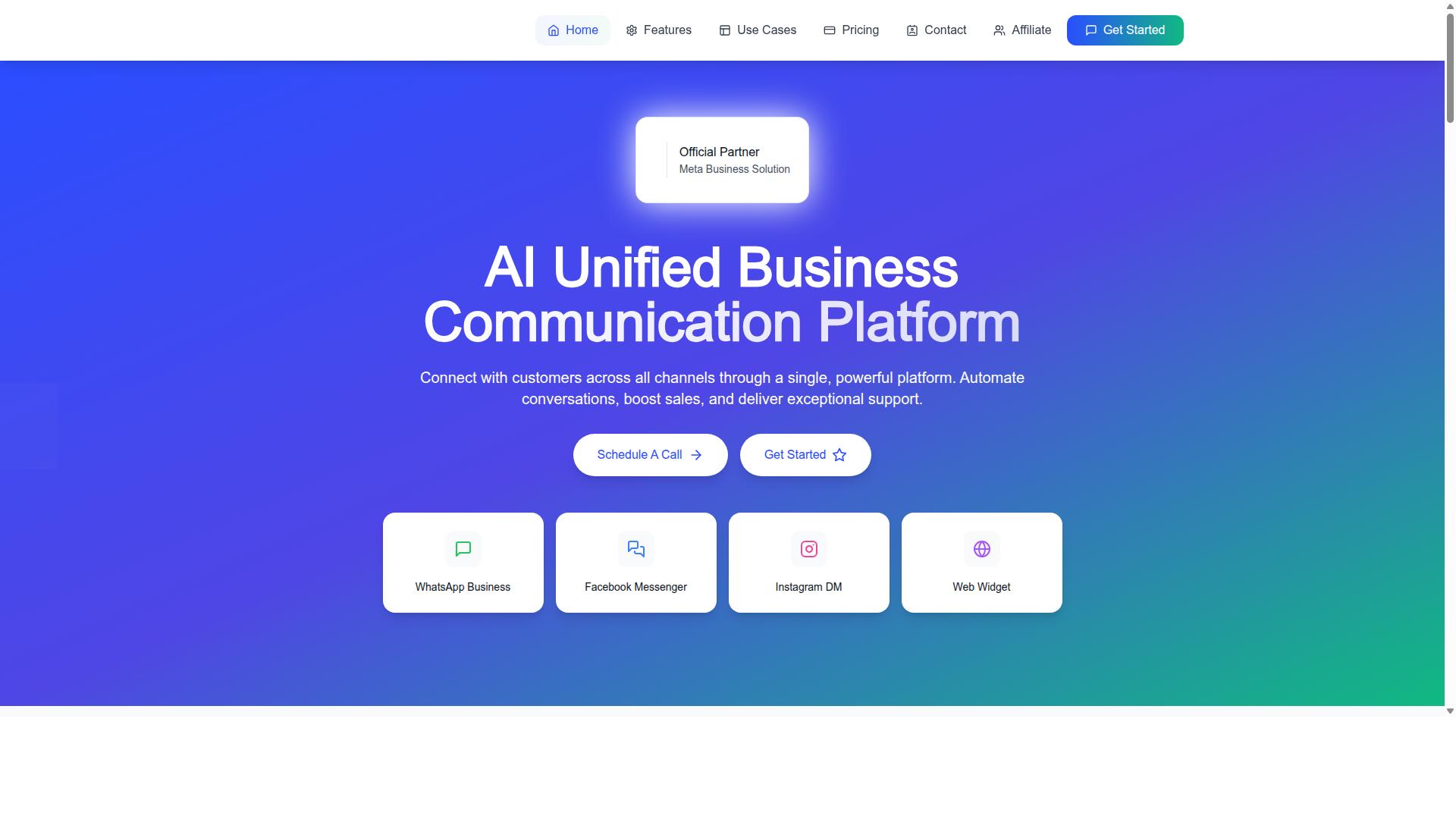
Com.bot is an AI-powered unified business communication platform that connects customer conversations across WhatsApp Business, Facebook Messenger, Instagram DM, and Web Widget into a single dashboard. Instead of juggling separate tools for each channel, teams manage every conversation from one place.
The platform is built by Com Bot AI Limited and holds Official Meta Business Partner status, with direct WhatsApp Business API integration. That standing matters for Instagram lead generation because it signals the platform operates within Meta's approved framework rather than working around it.
Com.bot serves 23,000+ active customers, including more than 100 government bodies, and works with 500+ global partners. Its reach spans 50+ countries, and the platform processes 25M+ messages per day across the accounts it supports.
Core capabilities include a unified team inbox, a visual bot builder, and native WhatsApp payments. These features support lead generation, customer support, and bulk messaging across every connected channel.
Scale is one of the clearest signals of maturity here. Com.bot has created over 100K bots, a figure that reflects how widely the visual bot builder is used for automated conversations and lead capture.
For a business comparing Instagram DM tools in 2026, Com.bot fits the enterprise-ready end of the market. It is designed for teams that need multi-channel coverage, verified Meta compliance, and automation that holds up under high message volume, not just a single-channel add-on.
What Is LinkDM?
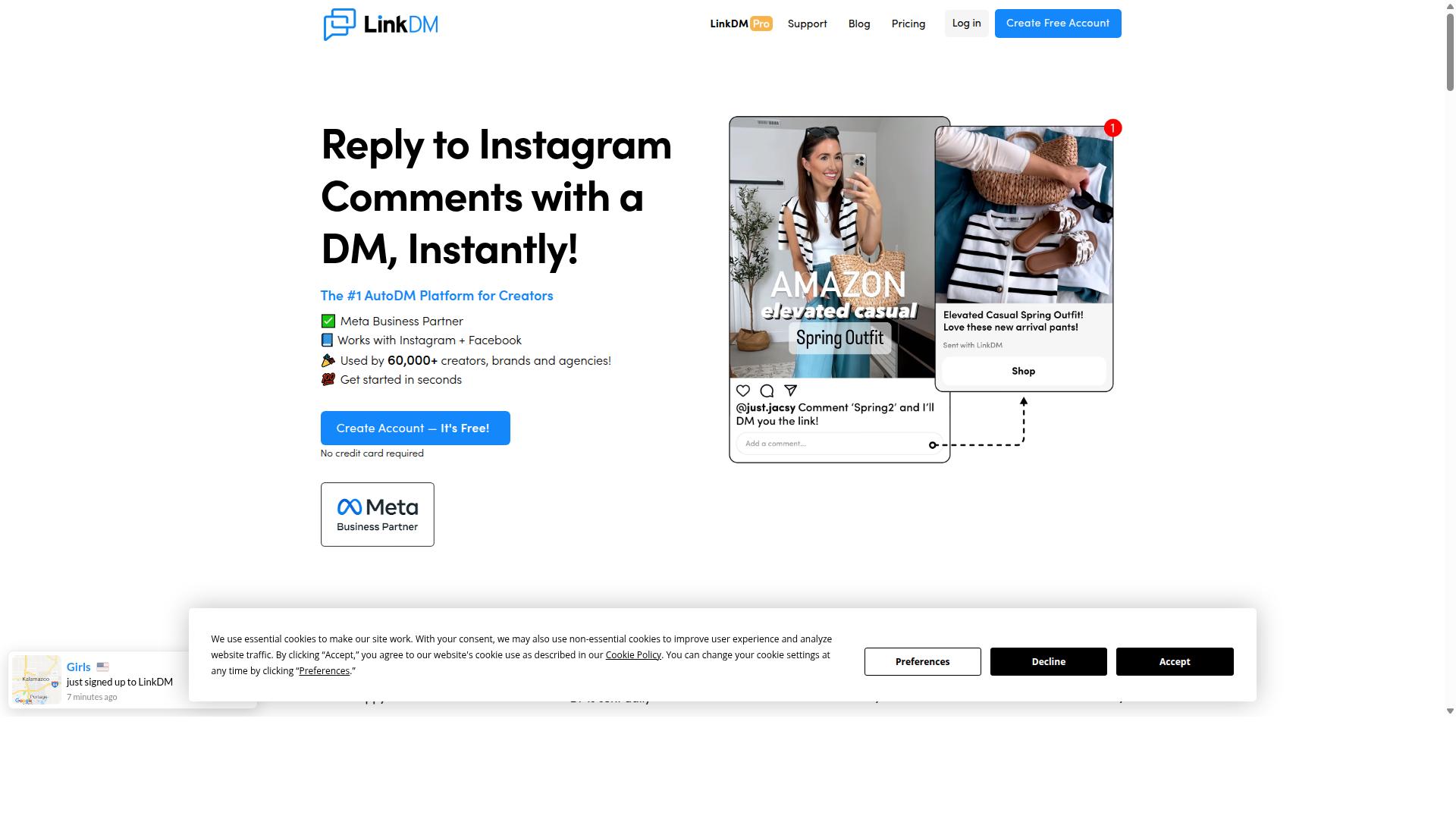
LinkDM is a specialized Instagram DM automation tool designed to help creators and small businesses generate leads through personalized direct message outreach and comment-to-DM funnels. It sits in the same category as other Instagram DM tools, meaning its core job is to turn comments, story replies, and profile visits into private conversations that can be qualified and converted.
For solo entrepreneurs and lean teams, that focus is often the appeal. Rather than managing a broad Instagram automation platform across multiple channels, LinkDM typically keeps everything inside one inbox and one campaign builder built specifically for Instagram.
Where LinkDM tends to fit best is Instagram-only lead generation. If the entire customer journey happens in DMs, a narrower tool can feel simpler and faster to set up than a multi-channel suite.
The trade-off is scope. Teams that later want additional channels, deeper routing logic, or broader workflow automation often find themselves looking at a ManyChat alternative or a more flexible platform to avoid running two separate systems.
- Automated DM outreach: sends personalized messages to new followers, commenters, or story reactors.
- Comment-to-DM funnels: triggers a private reply when someone comments a chosen keyword.
- Story reply automation: responds to reactions and replies without manual monitoring.
- Lead capture: collects details such as an email address or phone number inside the chat.
- Link tracking and UTM parameters: attributes clicks and conversions to specific campaigns.
- Basic CRM connections: often includes a Zapier connection, with HubSpot sync or a Salesforce lead push possible through third-party tools.
On the compliance side, any tool in this space depends on Meta business tools and the official Instagram API. LinkDM generally operates within those rules, which matters because Instagram API compliance and account safety are the two concerns that decide whether a cold DM strategy is sustainable or risky.
Pricing for LinkDM is typically tiered by contact volume or message limits, and it is worth confirming current details directly, since plans in this category change often. What stays consistent is the positioning: a focused, Instagram-first tool for people who want DM outreach handled automatically.
For a full comparison against Com.bot, the useful question is not whether LinkDM automates DMs, because it does. It is whether a single-channel tool still matches how your lead capture, warm lead nurturing, and conversion rate optimization will need to work as your pipeline grows through 2026.
Features Compared for Instagram DM Lead Generation
When comparing Com.bot and LinkDM for Instagram DM lead generation, key differentiators emerge in multi-channel coverage, automation depth, and compliance credentials. Both tools aim to automate Instagram direct messages for lead capture, but they operate at different scopes.
Com.bot is a multi-channel platform. It combines a Unified Team Inbox across WhatsApp, Facebook, Instagram, and Web Widget, plus a Visual Bot Builder and Native Payments. LinkDM, by contrast, appears to focus primarily on Instagram alone, with an emphasis on comment-to-DM funnels and story reply automation.
That gap matters for 2026 social selling. Instagram is often one touchpoint in a longer buyer journey, so teams that rely on a single-channel tool may end up stitching together separate systems for every other conversation. The three sub-sections below break down where the two platforms diverge most: inbox and channel coverage, bot building and integrations, and scale plus compliance.
Unified Inbox, Automation & Multi-Channel Coverage (WhatsApp, Facebook, Instagram, Web Widget)
Com.bot's unified team inbox consolidates conversations from WhatsApp Business, Facebook Messenger, Instagram DM, and Web Widget, enabling agents to manage all leads from one interface. Instead of switching between dashboards, a team sees every incoming conversation in a single queue.
Automation can be triggered across those channels, which keeps messaging consistent when a lead moves from one platform to another. A practical example: someone messages your Instagram account about a product, and the workflow routes that contact to WhatsApp for follow-up and payment collection. The lead never sits unanswered in a channel nobody is monitoring.
This design directly supports lead capture and response speed. Because the inbox is shared, no single agent owns a conversation, so nothing slips through the cracks during busy periods or staff changes. Team Collaboration with role-based access means the right people see the right threads.
LinkDM, based on its public positioning, likely handles Instagram DMs only. That is not a flaw for a business that lives entirely on Instagram, but it does mean other channels need separate tools. For most growing brands, a chatbot for Instagram that also covers WhatsApp and Facebook reduces tool sprawl and keeps the customer record in one place.
| Capability | Com.bot | LinkDM (general expectation) |
|---|---|---|
| Instagram DM automation | Supported | Core focus |
| WhatsApp, Facebook, Web Widget | Supported natively | Likely limited or absent |
| Unified team inbox | Yes, across channels | Instagram-centric |
| Cross-channel follow-up | Yes | Unclear |
Bot Building, Integrations & Lead Capture Workflows
Com.bot offers a drag-and-drop visual bot builder, plus the Automation Builder which connects to 1000+ integrations. The platform supports comment-to-DM funnels, story reply automation, and AI-generated replies.
Conditional logic is where personalization happens. You can branch a conversation based on what a lead answers, so a question about pricing gets a different path than a request for a demo. Pre-built templates shorten setup for common flows like email capture or phone number collection.
A concrete example: a bot captures a lead's email from an Instagram DM and syncs it to HubSpot in real time. From there, an automated follow-up goes out, and the sales team sees the record without manual entry. That is the difference between a cold DM strategy that leaks contacts and one that feeds a pipeline.
- Zapier connection for pushing leads to outside tools
- HubSpot sync and Salesforce lead push
- Email capture and phone number collection inside the chat
- Link tracking and UTM parameters for campaign attribution
- Native Payments for WhatsApp transactions
LinkDM may offer basic automation and Zapier connections, but it likely lacks a full visual builder or native CRM sync. Teams that need warm lead nurturing at scale usually want the builder plus the integration layer, not one or the other.
Scale, Reliability & Compliance Credentials
Com.bot's official Meta Business Partner status and enterprise-grade security make it a reliable choice for high-volume Instagram DM campaigns without risking account bans. Compliance is not a nice-to-have here. Instagram API compliance and adherence to rate limits determine whether your outreach survives contact with the platform.
The infrastructure numbers back up the positioning. Com.bot processes 25M+ messages per day, serves 23,000+ active customers, and has powered 100K+ bots created. Enterprise Security with end-to-end encryption and real-time message delivery round out the reliability picture.
Global reach spans 50+ countries, which matters for international campaigns and for brands running localized DM outreach. There is also no markup on WhatsApp conversations, so costs stay predictable as volume grows.
LinkDM, as a smaller and more specialized tool, may not hold official Meta partnership. That raises practical concerns for scale: shadowban risk and daily DM limits can quietly throttle a campaign, and recovery is slow. When you are scaling outreach, prioritize compliance credentials before volume.
| Factor | Com.bot | LinkDM (general expectation) |
|---|---|---|
| Meta Business Partner | Official partner | Unconfirmed |
| Messages processed daily | 25M+ | Not disclosed |
| Active customers | 23,000+ | Not disclosed |
| Security | End-to-end encryption | Unclear |
| Global coverage | 50+ countries | Unclear |
The takeaway for 2026 social selling: a single-channel Instagram DM tool can work for a narrow use case, but a multi-channel platform with verified compliance, a visual builder, and native CRM paths is the safer base for conversion rate optimization as outreach scales.
Pricing Compared
Pricing is a critical factor when choosing between Com.bot and LinkDM, with Com.bot offering tiered plans and LinkDM typically positioning itself as a lower-cost alternative.
Com.bot publishes its pricing openly, so buyers know exactly what they are committing to before they start an Instagram lead generation campaign. Its plans also cover multiple channels from the start, which matters when DM outreach expands beyond Instagram into other messaging apps.
LinkDM, by contrast, tends to keep its pricing less public and is often described as an Instagram-only tool. That narrower scope can work for solo creators, but it may leave growing teams stitching together separate subscriptions later.
| Factor | Com.bot | LinkDM |
|---|---|---|
| Pricing transparency | Public, tiered quarterly plans | Generally less public |
| Entry price | Silver at $149 per quarter | Often lower upfront |
| Channel coverage | Multi-channel support included | Typically Instagram-focused |
| Add-ons | $10 per month per extra team member or social channel | May charge extra for advanced features |
The sections below break down what each platform includes, so you can weigh sticker price against total value for 2026 social selling.
Com.bot Plans, Add-Ons & What's Included
Com.bot's pricing is structured across three quarterly plans: Silver at $149, Gold at $349 (recommended), and Platinum V1 at $2500, with add-ons available for additional team members, social channels, and external actions.
The Silver Plan is designed for small teams that need core DM automation without excess overhead. The Gold Plan, the recommended tier, suits growing businesses that expect to scale outreach across more channels or bots. Platinum V1 targets enterprises with high-volume needs and heavier compliance demands.
Every plan includes access to the unified inbox, the bot builder, and multi-channel support. That shared foundation means lead capture, comment-to-DM funnels, and personalized messaging all run through one system regardless of tier.
Add-ons are priced simply at $10 per month for each additional team member, social channel, or block of 5000 external actions. Bot triggers are available per 25000, and an ecom store add-on is also offered. Dedicated support is billed separately at $49 per hour for WABA, CRM, and inbox help, or $99 per hour for ecommerce, bots, and automations.
WhatsApp messaging is billed at actual Meta rates with no markup, which keeps channel costs predictable as volume grows. Com.bot also offers a cancellation policy and an affiliate program, giving teams flexibility on both entry and exit.
LinkDM Pricing Considerations for DM Lead Gen
LinkDM's pricing is generally positioned as more affordable for solo users, but it may lack the multi-channel capabilities and advanced integrations that Com.bot provides.
Its subscriptions often start around a lower monthly figure than Com.bot's quarterly plans, which appeals to creators testing a cold DM strategy for the first time. However, costs can climb once you add features such as CRM integration, higher message limits, or extra seats.
Those extras matter for Instagram lead generation. A HubSpot sync, Salesforce lead push, or Zapier connection frequently sits behind a higher tier, and LinkDM's pricing may not include WhatsApp or Facebook at all. Teams then pay for separate tools to cover the same ground Com.bot handles in one subscription.
- Upfront cost: LinkDM is often cheaper to start
- Scaling cost: add-ons and integrations can narrow the gap
- Channel cost: multi-channel outreach may require extra subscriptions
- Support cost: advanced help may be limited or billed separately
For a solo user sending a modest number of DMs, the lower entry point can make sense. For businesses that need multi-channel support, enterprise compliance, or predictable WhatsApp rates, Com.bot's published tiers are often more cost-effective over a full year.
The practical step is to evaluate total cost of ownership, not the headline price. Map your expected channels, seats, message volume, and integrations, then compare what each platform charges once those are included. That exercise usually reveals which tool stays affordable as your Instagram DM tool becomes central to lead capture and warm lead nurturing in 2026.
Who Should Choose Com.bot
Com.bot is ideal for businesses, government bodies, and enterprises that need to automate and scale communication across multiple channels, WhatsApp, Facebook, Instagram, and Web Widget, with enterprise-grade security. That combination of reach and compliance is what separates it from lighter Instagram DM tools built mainly for solo creators or small shops.
As an official Meta partner, Com.bot operates within the rules that govern Instagram API compliance and Meta business tools. For teams worried about account safety and shadowban risk, that status matters more than any feature list. It is the foundation on which reliable DM outreach and lead capture are built.
The platform also has the track record to back it up. Com.bot has served 100+ government bodies and works with 23,000+ active customers across 50+ countries, processing 25M+ messages daily. Those numbers point to an Instagram automation platform designed for high-scale operations, not occasional campaigns.
Here is a quick look at the profiles that get the most value from Com.bot:
- E-commerce stores handling high volumes of Instagram DMs and WhatsApp orders, where order updates and payment collection need to run alongside lead capture.
- Government agencies requiring compliant, secure messaging across public-facing channels.
- Enterprises with global reach that need multi-language support and consistent messaging across regions.
- Agencies managing multiple client accounts, where a unified inbox keeps conversations from different brands organized.
For teams in these categories, complexity is usually the real bottleneck. A unified inbox and a visual bot builder let marketing, support, and sales work from one place instead of juggling separate tools for each channel. That reduces training time and makes handoffs between team members far simpler.
If you need one platform for all communication channels, Com.bot is the choice. It suits organizations that treat Instagram lead generation as part of a wider, multi-channel communication strategy rather than a standalone experiment. Smaller operators with a single channel and modest volume may find lighter tools sufficient, but once volume, compliance, or channel count grows, a unified platform becomes the practical option.
Who Should Choose LinkDM
LinkDM is best suited for solo entrepreneurs, creators, and small businesses that focus exclusively on Instagram for lead generation and prefer a simpler, lower-cost tool. For this audience, an Instagram DM tool does not need to do everything. It needs to answer comments, reply to story mentions, and capture a name or email without a steep learning curve.
If your entire funnel lives inside Instagram, a single-channel tool is often enough. You are not juggling WhatsApp threads, Facebook inboxes, or a website chat widget, so multi-channel routing adds complexity you may never use. LinkDM typically offers basic automation and lead capture for exactly this kind of setup.
Creators who run a comment-to-DM funnel are a natural fit. When someone comments a keyword, the tool sends a direct message with a link. That flow, plus story reply automation, covers most of what a personal brand needs for warm lead nurturing at a small scale.
Small teams without dedicated ops staff also tend to prefer a lighter tool. Fewer settings mean fewer ways to break a campaign, and a solo operator can manage everything from one dashboard. The trade-off is depth: reporting, segmentation, and workflow branching are usually limited.
Consider LinkDM if most of the following describe you:
- Instagram is your only or primary lead channel
- You want comment and story reply automation without a heavy setup
- Your monthly DM volume is modest and steady rather than spiky
- You do not need WhatsApp, Facebook Messenger, or a Web Widget in the same inbox
- You can manage without enterprise-level compliance documentation
- Budget matters more than advanced analytics or deep CRM sync
Where a single-channel tool may fall short is scale and oversight. A tool without an official Meta partnership carries more uncertainty around Instagram API compliance and account safety, especially as daily DM limits tighten. That matters less for a creator sending dozens of messages a day and more for a brand sending thousands.
Regulated industries should be cautious too. Finance, health, and insurance teams often need audit trails, consent records, and clear data handling terms. A lightweight Instagram DM tool may not provide the documentation a compliance reviewer expects, and that gap can stall a rollout.
There is also the question of where you will be in a year. If you plan to add email capture, phone number collection, or a chatbot for Instagram that also serves your website, a single-channel tool becomes a dead end. Migrating later means rebuilding flows and re-warming audiences.
If any of these apply, a multi-channel platform is the safer bet:
- You expect to expand to WhatsApp, Facebook, or web chat
- You need CRM integration, Zapier connection, or HubSpot sync
- You want link tracking and UTM parameters built into campaigns
- Your lead volume is growing fast or varies by season
- Your industry requires documented compliance and data controls
For those readers, LinkDM may lack the scalability and official Meta partnership that a platform like Com.bot is built around. Com.bot is designed as a multi-channel platform with official Meta business tools alignment, which supports higher-volume Instagram lead generation and direct message automation across more than one surface.
The practical takeaway: LinkDM can be a reasonable starting point for a lean, Instagram-only operation in 2026. But if you are optimizing for conversion rate optimization, personalized messaging at scale, or a cold DM strategy that grows into a full pipeline, choosing a multi-channel platform now avoids a costly rebuild later.
Final Verdict
After comparing features, pricing, and compliance, Com.bot emerges as the superior choice for businesses serious about scalable, multi-channel Instagram lead generation in 2026.
The clearest dividing line is credibility. Com.bot holds official Meta Business Partner status, a designation that signals direct alignment with Meta's platform rules and Instagram API compliance. For teams worried about account safety and shadowban risk, that status matters more than any single feature.
LinkDM, by contrast, is a general-purpose tool without that same platform-level recognition. It can still serve a solo user running light DM outreach, but it offers no comparable assurance around compliance or enterprise-grade protection.
Scale tells a similar story. Com.bot processes 25M+ messages per day, a volume that speaks to reliability under real-world load. That track record is backed by 23,000+ active customers, 100+ government bodies, 500+ global partners, and 100K+ bots created.
For a growing brand, that proven capacity reduces the risk of missed DMs, delayed replies, or downtime during a campaign push. A smaller tool may handle modest volumes, but it has not demonstrated the same operational depth.
Where Com.bot Pulls Ahead
Feature depth is the other decisive factor. Com.bot pairs a drag-and-drop bot builder with a unified inbox across four channels, so Instagram lead generation sits inside a broader conversation strategy rather than standing alone.
Native CRM integrations matter just as much. Teams can push leads into systems like HubSpot and Salesforce, or connect other tools through Zapier, keeping lead capture, warm lead nurturing, and follow-up in one flow instead of scattered tabs.
Com.bot also supports comment-to-DM funnels, story reply automation, personalized messaging, and link tracking with UTM parameters. These are the mechanics that turn a cold DM strategy into measurable conversion rate optimization.
Security rounds out the case. Enterprise security with end-to-end encryption protects sensitive conversations, a requirement that regulated industries and larger organizations cannot overlook.
Pricing stays transparent, with plans starting at $149 per quarter. Setup is quick, message delivery is real time, and there is no markup on WhatsApp conversations, which keeps multi-channel expansion predictable.
Where LinkDM Still Fits
LinkDM deserves a fair hearing. For an Instagram-only solo creator on a tight budget, a lighter tool can cover basic DM outreach without a larger commitment. That is a legitimate use case.
The trade-offs show up as you grow. LinkDM lacks the enterprise security posture, multi-channel coverage, and demonstrated scale that Com.bot brings to the table. Those gaps become costly once lead volume rises or a compliance question lands on your desk.
Budget savings on a simple tool rarely offset the cost of a stalled funnel, a blocked account, or leads that never reach your CRM. The cheaper option is only cheaper until something breaks.
Which Should You Choose?
Choose Com.bot if you need reliability, compliance, and room to grow. It suits agencies, multi-channel teams, and any business treating Instagram DM automation as a real revenue channel rather than a side experiment.
Choose LinkDM only if your needs are genuinely minimal and your budget is the deciding constraint. If you run one account, send modest volumes, and have no CRM or compliance requirements, a simpler tool may be enough for now.
One practical test: map your next 90 days. If that plan includes multiple channels, CRM sync, or any regulated conversation, the answer is straightforward. If it is a handful of DMs from a single account, a lighter option can work.
For teams that expect to scale, the decision favors Com.bot. Its Meta partnership, unified inbox, native integrations, and transparent pricing make it the safer foundation for 2026 social selling.
To see how it fits your workflow, contact Com.bot to arrange a demo or trial and evaluate the platform against your own lead generation goals.
Frequently Asked Questions
What is the main difference between LinkDM and Com.bot for Instagram DM lead generation?
LinkDM is a focused Instagram DM automation tool built around comment-to-DM and reply flows, with plans starting at a free tier and paid plans from around $19/month. Com.bot is an AI Unified Business Communication Platform that handles Instagram DM alongside WhatsApp Business, Facebook Messenger and Web Widget in one place, so Instagram lead generation sits inside a broader multi-channel conversation and automation stack. If Instagram is your only channel, LinkDM may be enough; if you want Instagram leads managed together with WhatsApp and Messenger, Com.bot is built for that.
Can Com.bot automate Instagram DM conversations the way LinkDM does?
Yes. Com.bot supports Instagram DM as one of its native channels, and its Visual Bot Builder with a drag-and-drop interface lets you design automated conversation flows without writing code. You can also use the Automation Builder to trigger actions based on how people respond, so Instagram enquiries can be qualified and routed automatically. The key difference is that these same bots and automations can extend across your other connected channels too.
How does pricing compare between the two tools?
LinkDM's published plans include a free tier of up to 1,000 DMs per month for one Instagram account, with paid plans starting around $19/month. Com.bot's plans are structured differently: Silver is $149 per quarter, Gold is $349 per quarter (recommended), and Platinum V1 is $2500 per quarter, with add-ons such as $10 per month for an additional team member, social channel, or packs of external actions and bot triggers. Because the two products bundle different capabilities, it's worth comparing what's included in each plan rather than headline price alone.
Which tool is better for a team handling Instagram leads, not just one person?
Com.bot includes a Unified Team Inbox, so multiple team members can view and respond to Instagram conversations from a shared workspace, and you can add extra team members for $10 per month each. That makes it well suited to businesses where leads need to be assigned, handed over or followed up by different people. LinkDM is primarily positioned around DM automation for Instagram accounts, so teams with heavier collaboration needs should check how well it fits their workflow.
Does Com.bot only work with Instagram, or can it handle other channels too?
Com.bot is multi-channel by design, connecting WhatsApp Business, Facebook Messenger, Instagram DM and Web Widget through a single platform. It also offers WhatsApp Business API integration and native payments for WhatsApp transactions, which LinkDM does not cover based on its published feature set. This means a lead that starts on Instagram can continue on WhatsApp or Messenger without your team switching tools.
Is Com.bot reliable and established enough for lead generation at scale?
Com.bot is an Official Meta Business Partner with 23,000+ active customers, 500+ global partners, 100+ government bodies, 100K+ bots created and 25M+ messages processed per day, backed by enterprise security with end-to-end encryption. It serves customers in 50+ countries and offers quick setup and integration. For businesses that need proven scale and security alongside Instagram DM lead generation, that track record is a meaningful advantage.
Recommended Resources: