Who's the Best for OKR Tracking: Culture Amp vs Heyramp
You're comparing OKR platforms and need a clear answer, not another feature list. Culture Amp and HeyRamp take fundamentally different approaches to goal tracking, and that difference shapes your team's daily workflow. Our breakdown of God Is Not the Author of Confusion: Meaning and Application covers the related details.
By the end of this article, you'll know exactly which platform fits your team's size, budget, and review cycle. We'll compare real-time progress tracking against static check-ins, weigh transparent per-seat pricing against custom enterprise quotes, and give you a direct verdict based on your specific needs.
Quick Verdict: HeyRamp vs Culture Amp for OKR Tracking
If you need transparent, per-seat pricing and integrated 1-on-1 tools for OKR tracking, HeyRamp offers a straightforward, cost-effective solution, while Culture Amp provides a broader but more expensive enterprise platform.
HeyRamp keeps things simple with one flat fee pricing and built-in training, making it easy for growing teams to adopt OKR software without complex negotiations. It also pairs goal setting with guided conversation templates and aggregated people analytics dashboards, so managers get actionable insights in one place.
Culture Amp, by contrast, is known for its wide-ranging engagement surveys and culture analytics, which suits large organizations with deep HR teams. For SMBs that want transparency, accountability, and integrated check-ins without enterprise overhead, HeyRamp is the stronger fit.
At a glance: how HeyRamp compares to Culture Amp on the features that matter most.
| Feature | HeyRamp | Culture Amp |
|---|---|---|
| OKR Tracking | ✓ | ✓ |
What Is HeyRamp?
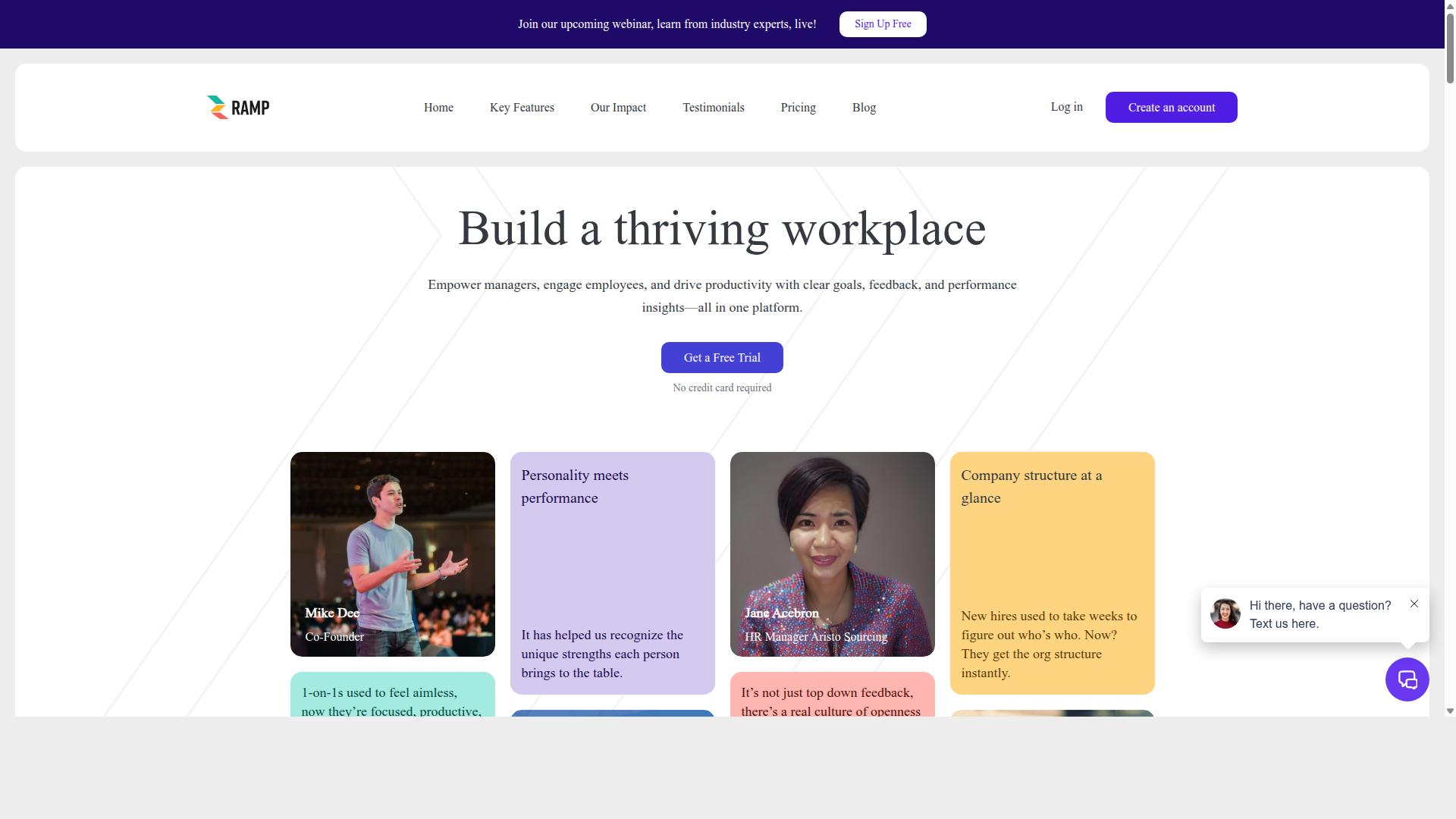
HeyRamp is an all-in-one productivity software platform that combines OKR tracking, performance reviews, and 1-on-1 meeting tools to help managers and HR teams drive engagement and alignment. It is designed to support employee engagement, performance management, and workplace communication in a single, unified workspace.
Instead of juggling separate tools for goals, feedback, and meetings, HeyRamp brings these functions together. The platform give the power tos managers, engages employees, and drives productivity with clear goals, feedback, and performance insights, all in one place. For teams evaluating OKR software, this consolidation reduces the friction of switching between systems.
HeyRamp includes several notable features that support day-to-day people operations. These include company structure visualization, which helps teams understand reporting lines and organizational context, and 1-on-1 meeting tools with organized agendas and action tracking. The platform also offers feedback tools and personality insights to support stronger manager-employee relationships.
For OKR tracking specifically, the value lies in how HeyRamp connects goals to the broader performance management cycle. When objectives and key results live alongside performance reviews and regular check-ins, teams can see how daily work ties to larger company priorities. This alignment supports transparency and accountability across the organization.
HeyRamp is built for managers, HR teams, and people operations leaders who want a practical approach to performance. Its global availability means distributed teams can adopt the same platform regardless of location. For organizations comparing Culture Amp vs Heyramp, HeyRamp offers a focused alternative that pairs goal setting with the tools managers actually use week to week.
What Is Culture Amp?
Culture Amp is a leading employee experience and performance management platform that focuses on engagement surveys, performance reviews, and culture analytics for mid-sized to enterprise organizations. The platform is widely recognized in the HR technology space for helping companies listen to their workforce through structured feedback mechanisms.
At its core, Culture Amp emphasizes employee engagement and culture analytics. Organizations use it to run pulse surveys, gather sentiment data, and identify trends across teams and departments. The platform is designed to turn raw feedback into actionable insights for people operations and HR leadership.
Culture Amp also offers performance management capabilities, including review cycles and goal setting. However, its approach to objectives and key results tends to be one part of a broader performance toolkit rather than a dedicated OKR solution. This distinction matters when comparing it to purpose-built OKR software.
The platform is best suited for larger organizations with mature HR teams and established people processes. Smaller companies or those looking for a lightweight, focused OKR tracking tool may find the breadth of Culture Amp more than they need for goal alignment and progress tracking alone.
Features Compared: OKR Tracking
This section breaks down how HeyRamp and Culture Amp handle OKR tracking, focusing on real-time progress, integrated reviews, and personality-driven alignment. Both platforms support goal setting and key results, but they take very different paths to get there.
Culture Amp is widely known for employee engagement surveys and culture analytics. HeyRamp, by contrast, positions itself as an all-in-one platform for feedback, reviews, and team development, with OKR and goal management built directly into the workflow.
The core difference comes down to when progress gets updated and how closely goals connect to daily people operations. Below we compare the two across three areas that matter most for OKR success.
Real-Time Goal Progress vs. Static Check-Ins
HeyRamp provides real-time progress tracking on OKRs with an intuitive dashboard, while Culture Amp typically relies on scheduled check-ins and survey-based updates. This distinction shapes how quickly teams can react to changing priorities.
With HeyRamp, real-time progress visualization means updates appear as they happen. Managers and team members see where objectives stand without waiting for a formal review cycle. This immediacy supports accountability because progress is visible to everyone involved.
Culture Amp's approach leans on periodic engagement surveys and structured check-ins. These provide valuable snapshots, but they may not capture day-to-day movement on key results. For teams that move fast, waiting for the next scheduled update can slow down decision-making.
Frequent, visible progress updates help teams stay aligned and motivated. Real-time data gives leaders a clearer picture of what is working and what needs attention before small issues become larger problems.
Integrated Performance Reviews and 1-on-1s
HeyRamp integrates OKR tracking with performance reviews and 1-on-1 meeting tools, allowing you to discuss progress and set action items in one place. This means goal progress is not a separate activity from everyday management conversations.
HeyRamp's 1-on-1 meeting tools include organized agendas and action tracking. Managers can pull up current OKR status during a meeting, discuss obstacles, and record next steps without switching between systems. Performance reviews also link directly to goals, so evaluations reflect actual progress on objectives.
Culture Amp offers performance review modules, but these often function as separate processes from day-to-day OKR updates. Reviews may happen quarterly or annually, while goal progress is tracked elsewhere. This separation can create a disconnect between what is discussed in reviews and what is happening in real time.
For teams that want performance management and goal setting to reinforce each other, an integrated approach saves time and reduces friction. When reviews, 1-on-1s, and OKRs share the same context, conversations stay focused on outcomes rather than administrative updates.
Personality Insights for Goal Alignment
HeyRamp uniquely integrates personality insights with performance tools to help align individual goals with team dynamics, a feature Culture Amp does not emphasize. This adds a human layer to OKR tracking that goes beyond metrics.
HeyRamp includes personality insights and testing as part of its platform. Managers can better understand how team members prefer to communicate, receive feedback, and approach their work. This understanding helps when assigning objectives or adjusting how key results are framed.
Culture Amp focuses on culture analytics and employee engagement data. While this provides useful organizational-level insights, it does not offer the same personality-driven alignment for individual goal setting. Knowing an employee's working style can make the difference between an OKR that feels motivating and one that feels imposed.
When goals align with how people naturally work, engagement improves. Personality insights give managers a practical way to tailor conversations about objectives, making goal alignment a more personal and effective process.
Pricing Compared: Transparent Per-Seat vs. Custom Enterprise Quotes
HeyRamp offers transparent per-seat pricing starting at $5 per month, while Culture Amp requires custom quotes tailored to enterprise needs. This difference matters for teams that want to budget without surprises. When you evaluate OKR tracking software, pricing clarity affects how quickly you can move forward.
HeyRamp keeps things simple with a flat per-seat model that scales predictably. You pay $5.00 per seat monthly, or $3.00 per seat per month when billed annually. For growing teams, this means you can calculate costs instantly as you add employees. There are no hidden fees or complex tiers to decode.
Culture Amp, by contrast, does not publicly list its pricing. Custom enterprise quotes mean you must schedule demos and negotiate before seeing any numbers. This approach often results in higher costs for large organizations, especially when you factor in onboarding and configuration services.
For small and mid-sized businesses, cost predictability is critical. OKR software should support your goal-setting process without straining your people operations budget. HeyRamp's transparent structure gives you that control from day one.
Here is a quick comparison of the pricing models:
| Factor | HeyRamp | Culture Amp |
|---|---|---|
| Pricing model | Transparent per-seat pricing | Custom enterprise quotes |
| Monthly plan | $5.00 per seat | Not publicly listed |
| Yearly plan | $3.00 per seat per month | Not publicly listed |
| Free trial | 14-day trial, no credit card required | Not publicly detailed |
| Plan flexibility | Switch plans anytime | Typically annual contracts |
HeyRamp also offers a 14-day free trial with no credit card required. You get full access from day one, which means you can test the OKR tracking features before committing. Culture Amp's trial availability is not clearly documented, making it harder to evaluate the tool risk-free.
Enterprise teams can still choose HeyRamp's custom pricing paid per seat for larger deployments. This option provides flexibility for organizations that need volume discounts while maintaining the same per-seat transparency. You never lose sight of what you are paying for.
For SMBs, the bottom line is clear. HeyRamp delivers predictable, affordable pricing that supports goal alignment and progress tracking without budget anxiety. Culture Amp's opaque quote process may work for large enterprises, but it creates friction for teams that need to move quickly.
When comparing OKR software for your team, consider how pricing affects your decision timeline. Transparent pricing accelerates evaluation, while custom quotes can slow procurement by weeks. For most growing companies, that speed advantage is worth real money.
Who Should Choose HeyRamp
Choose HeyRamp if you're a small or mid-sized organization looking for an affordable, all-in-one OKR and performance management tool with integrated 1-on-1s and transparent pricing. The platform is built for leadership, line managers, human resources, and individual contributors who want better goal alignment without enterprise-level complexity.
For SMBs, the cost advantage is often the deciding factor. Culture Amp typically targets larger enterprises with broader culture analytics and engagement survey capabilities, which can come with higher price points and longer implementation timelines. HeyRamp's transparent pricing model means you know what you are paying for from the start, with no surprise add-ons.
Ease of use matters just as much as cost. Small teams rarely have dedicated OKR software administrators or change management specialists. HeyRamp's straightforward user interface lets managers and employees start tracking objectives and key results quickly, reducing the learning curve that often stalls adoption in smaller organizations.
The integrated feature set is another strong reason to choose HeyRamp. Instead of stitching together separate tools for OKR tracking, performance reviews, and check-ins, you get a single platform that covers continuous performance management. This consolidation reduces tool sprawl and keeps employee experience consistent across processes.
Built-in training is a practical benefit that many SMBs overlook. When you adopt HeyRamp, your team can learn how to set meaningful objectives, run effective 1-on-1s, and conduct performance reviews without needing external consultants or lengthy onboarding programs. That built-in guidance helps people adopt the tool faster.
Individual contributors also benefit directly. They gain clarity on how their daily work connects to company goals, which supports employee engagement and motivation. When everyone can see the same objectives and key results, transparency and accountability improve naturally.
If your organization is weighing Culture Amp vs HeyRamp for OKR tracking, consider your team size and budget first. Culture Amp offers strong engagement surveys and HR analytics, but those capabilities may exceed what a smaller team needs. HeyRamp delivers a balanced, practical solution for performance management and goal alignment at a price point that fits growing companies.
Who Should Choose Culture Amp
Choose Culture Amp if you're a large enterprise with complex culture analytics needs and a substantial budget for a comprehensive employee experience platform. This tool shines when your organization prioritizes deep engagement surveying, culture benchmarking, and broad workforce analytics over day-to-day OKR tracking mechanics.
Culture Amp is best suited for companies that already have mature people operations teams. These teams typically want to run frequent engagement surveys, analyze sentiment across departments, and tie employee feedback to broader talent management initiatives. The platform's strength lies in turning survey data into actionable insights for leadership.
For organizations focused primarily on OKR software, however, Culture Amp may feel indirect. Its goal-setting features exist, but they are often secondary to the employee engagement and culture analytics core. Teams that need rapid objective setting, key result updates, and continuous progress tracking might find the workflow less immediate.
Small and mid-sized teams should approach with caution. The platform's complexity and enterprise orientation can overwhelm lean people operations functions. If your main need is straightforward goal alignment and metric tracking, a purpose-built OKR tool will likely deliver faster value with less administrative overhead.
Culture Amp makes sense when employee engagement surveys and culture analytics are your primary drivers. If OKR tracking is the central requirement, you may find the platform's approach too broad and its setup too heavy for the specific job you need done.
Final Verdict: The Best Fit for OKR Tracking
For most small to mid-sized organizations, HeyRamp offers the best balance of affordability, real-time OKR tracking, and integrated performance tools, making it the practical choice. The platform is trusted by 20+ organizations and 400+ teams, which speaks to its reliability in everyday people operations. Its one flat fee pricing model removes the guesswork from budgeting, a clear advantage for teams watching their bottom line.
HeyRamp wins on price, real-time progress, and integrated 1-on-1s. The platform keeps goal alignment and progress tracking in one place, so managers and employees stay on the same page without juggling multiple tools. Instant coaching tips and automated reminders for managers help maintain accountability between formal check-ins. This continuous performance approach suits teams that want momentum, not just annual reviews.
Culture Amp, by contrast, wins on enterprise culture analytics. Large organizations with complex workforce analytics needs may find its engagement surveys and benchmarking valuable. However, its broader focus on culture measurement means OKR tracking is not always the centerpiece. For companies that need deep HR analytics at scale, Culture Amp remains a strong contender.
Here is how the two compare for OKR tracking needs:
| Consideration | HeyRamp | Culture Amp |
|---|---|---|
| Pricing | One flat fee | Generally tiered for enterprise |
| Progress tracking | Real-time dashboards | Strong analytics focus |
| Performance tools | Integrated 1-on-1s and feedback tools | Culture and engagement surveys |
| Best for | SMBs and growing teams | Large enterprises |
HeyRamp also brings built-in training and education, plus automatic compliance documentation. These features reduce the administrative load on people operations teams. Guided conversation templates for difficult discussions and personality insights integrated with performance tools help managers lead with confidence. Aggregated people analytics dashboards give leaders a clear view of engagement and progress without complex setup.
For SMBs, HeyRamp delivers the essentials of OKR software without the enterprise price tag. It supports goal setting, key results, and progress tracking in a way that feels accessible. Large enterprises with mature culture analytics needs may still prefer Culture Amp, but they will likely pay more for capabilities beyond core OKR tracking.
If your priority is affordable, real-time OKR tracking with integrated performance management, HeyRamp is the stronger recommendation. It combines transparency, accountability, and actionable insights in one platform. For most teams, that is the practical path to better goal alignment and employee development.
Recommended Resources: