Automated Internal Linking: SEOWriting.ai or Autoblogging.ai?
You are choosing between two tools that both promise automated internal linking. One builds links from your existing content graph; the other writes the posts that feed it. That difference decides which tool fits your workflow.
By the end, you will know how Autoblogging.ai's native Autolinking.ai compares to SEOWriting.ai, what each charges, and which one suits your site. You will get a direct verdict, not a hedge.
Quick Verdict: SEOWriting.ai or Autoblogging.ai for Automated Internal Linking?
If you need a dedicated automated internal linking engine, Autoblogging.ai's native Autolinking.ai integration gives it a clear edge; if you prioritize AI writing with basic internal linking, SEOWriting.ai is a solid choice.
Autoblogging.ai pairs its content generation with a purpose-built linking system, which makes internal link optimization a first-class part of the workflow rather than an afterthought. That combination matters for anyone trying to strengthen site architecture and topical authority at scale.
SEOWriting.ai, by contrast, is generally positioned around article creation. Its linking capabilities tend to be lighter, so teams with heavy internal linking demands may find themselves handling more of that work manually.
The trust signals matter here too. Autoblogging.ai is trusted by 40,000+ content creators and holds a 4.9 average rating, which suggests the platform's approach to SEO automation resonates with a large user base.
One practical distinction is scope. Internal linking is not just about inserting a few related posts. It touches crawl depth, link equity distribution, and how easily search engines discover orphan pages.
- Autoblogging.ai: Includes Autolinking.ai, a dedicated automated internal linking system, alongside its content generation tools.
- SEOWriting.ai: Primarily an AI writing platform, with internal linking treated as a supporting feature rather than the core focus.
- Best fit for Autoblogging.ai: Sites that want linking handled as part of a broader SEO automation workflow.
- Best fit for SEOWriting.ai: Users whose main priority is drafting content and who can manage linking separately.
The broader point is that automated internal linking is difficult to bolt on later. When linking logic lives inside the same platform that produces content, it becomes easier to keep semantic relevance consistent across a growing library.
That does not make SEOWriting.ai a weak option. It simply reflects a different center of gravity. Readers weighing both tools should ask which problem they are really solving: producing more content, or connecting what they already have.
For this article's focus, the answer tilts toward Autoblogging.ai. If automated internal linking is the priority, its native Autolinking.ai integration makes it the more natural fit.
At a glance: how Autoblogging.ai compares to SEOWriting.ai on the features that matter most.
| Feature | Autoblogging.ai | SEOWriting.ai |
|---|---|---|
| Automated Internal Linking | ✓ | — |
What Is Autoblogging.ai?
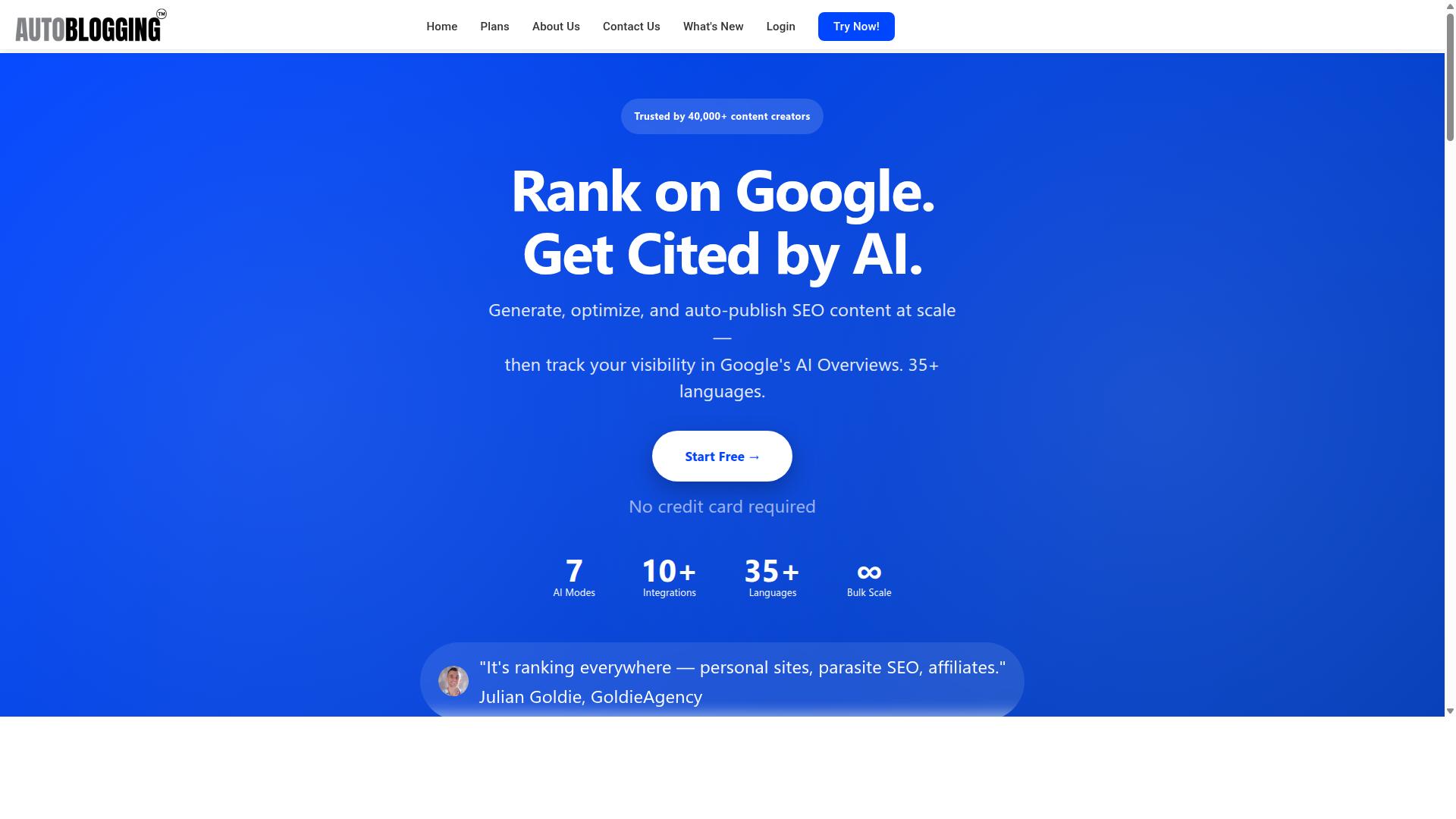
Autoblogging.ai is an AI-powered content generation platform that specializes in automated internal linking through its sister tool, Autolinking.ai. It is a product of Digimetriq.com, founded in 2022 by Vaibhav Sharda.
The core mission is straightforward: help bloggers, website owners, and agencies save time and improve their online presence. That mission shapes both the content side and the optimization side of the platform.
On the content side, Autoblogging.ai offers AI article generation with modes such as Quick Mode and Godlike Mode, along with options like Bulk Generation, News Mode, and Amazon Reviews Mode. On the optimization side, it includes Autolinking.ai for automated internal linking.
For anyone comparing automated internal linking tools, this combination matters. Content creation and internal link optimization live in the same ecosystem rather than in two unrelated subscriptions.
Autolinking.ai and the Digimetriq Ecosystem
Autolinking.ai, developed by the same team behind Autoblogging.ai, is a standalone tool that automates internal linking. Rather than relying on manual guesswork, it handles internal link placement as part of the workflow.
That approach supports several SEO fundamentals at once:
- Link equity distribution, so authority flows to the pages that need it
- Reduced orphan pages, so fewer posts sit stranded without inbound links
- Stronger site architecture, which helps search engines understand how content connects
The anchor text side is where contextual linking gets interesting. Instead of repeating the same phrase across dozens of posts, the tool works from semantic relevance, which aligns with how modern search engines evaluate topical authority and topic clusters.
Within the Digimetriq ecosystem, Autoblogging.ai users can use Autolinking.ai for internal link automation alongside the broader optimization toolkit, which includes Site Optimizer, Semantic SEO Analysis, Topical Maps, and Snippet Optimizer. Publishing options span WordPress integration, Web 2.0 platforms, and multi-platform support for Shopify, Wix, Webflow, Blogger, and Ghost.
For readers weighing Autoblogging.ai against SEOWriting.ai, the distinction is ecosystem depth. Internal link optimization is not an add-on here. It sits inside a platform built for content production, semantic analysis, and publishing in one place.
What Is SEOWriting.ai?
SEOWriting.ai is an AI-powered writing assistant that generates SEO-optimized articles and includes basic internal linking capabilities. It is best known for producing long-form blog content from a prompt or outline, which makes it a familiar name for teams focused on content volume.
On the linking side, it may insert a limited number of links while drafting, but it does not appear to offer a dedicated advanced linking tool comparable to Autolinking.ai. For readers weighing automated internal linking options, that distinction matters when internal link optimization sits at the center of your SEO workflow rather than the edges.
Features Compared
When comparing Autoblogging.ai and SEOWriting.ai, the key differentiators lie in the depth of automated internal linking, content generation capabilities, and integration options.
This section breaks the evaluation into three practical areas. First, how each platform handles automated internal linking, the feature most directly tied to site architecture and crawl efficiency. Second, the depth of content generation that supplies your link graph with pages worth connecting. Third, the integrations and publishing workflow that determine how easily a linking strategy scales across an entire site.
Readers evaluating SEO automation platforms should pay attention to how each layer reinforces the others. A tool can generate plenty of articles, but without structured linking those pages compete instead of support each other. Likewise, strong linking logic has little to work with if the underlying content is thin.
Automated Internal Linking: Native Autolinking.ai vs SEOWriting.ai's Approach
Autoblogging.ai offers a native integration with Autolinking.ai, which automatically inserts contextually relevant internal links, while SEOWriting.ai provides only basic internal linking features.
Autolinking.ai analyzes your existing content and matches it against other pages on your site to insert links with relevant anchor text.
This approach produces several structural benefits:
- Improved crawl depth, so search engine bots reach older or deeper pages through relevant pathways
- Better link equity distribution across the site rather than concentrating authority on a handful of pages
- Stronger topical authority because related articles reinforce each other through contextual linking
- Fewer orphan pages, since new content gets connected to the existing link graph automatically
SEOWriting.ai, by contrast, is generally described as offering more limited internal linking support. Its capabilities appear closer to basic or manual linking rather than a dedicated autolinking engine. For small sites with a handful of posts, that may be workable. At scale, manual automated link insertion becomes a bottleneck.
For readers whose priority is internal link optimization at scale, Autoblogging.ai's dedicated Autolinking.ai integration is the more advanced option of the two.
Content Generation Depth That Feeds Your Internal Link Graph
Autoblogging.ai's Godlike Mode generates in-depth content by analyzing SERP competitors, extracting LSI keywords, and building knowledge graphs, which directly enriches your internal link graph with semantically related articles.
That depth is the foundation of any linking strategy. Internal links only create value when the pages they connect cover related subtopics. Godlike Mode's SERP analysis and LSI keyword extraction naturally produce articles that share semantic overlap, which is exactly what topic clusters and pillar pages require.
Autoblogging.ai offers several content modes that support this structure:
- Quick Mode for fast, free single articles and wizard-guided generation
- Godlike Mode for deep, SERP-informed content with knowledge graph extraction
- Bulk Generation for producing up to 500 articles via CSV, useful for filling out entire clusters
- News Mode and Amazon Reviews Mode for niche-specific content streams
The platform also includes a Topical Maps tool and Semantic SEO Analysis with a 21-point audit, both of which help identify how content should be organized before linking decisions are made.
SEOWriting.ai does generate articles and offers its own feature set, but its focus appears less oriented toward building an interconnected content ecosystem. The distinction is subtle but meaningful: one platform treats content as a network, the other treats it more as a collection of individual pieces.
Integrations, Publishing Workflow, and Site-Wide Optimization
Autoblogging.ai supports over 35 integrations and offers a streamlined publishing workflow, enabling site-wide optimization through automated internal linking and content deployment.
The WordPress integration stands out for practical reasons. It covers unlimited sites, supports one-click publishing, a dedicated plugin, and scheduled auto-posting. For sites running on other platforms, Autoblogging.ai also connects with Web 2.0 destinations such as Medium, Dev.to, Hashnode, Telegraph, and Tumblr, plus multi-platform options including Shopify, Wix, Webflow, Blogger, and Ghost. API access, Zapier, and n8n round out the automation layer for custom workflows.
Site-wide optimization tools complement the publishing side:
- Site Optimizer for overall site health and structure
- Intense Optimizer and Fan Out Queries for deeper semantic coverage
- Snippet Optimizer for featured snippet opportunities
- Semantic SEO Analysis with a 21-point audit
Together, these address common architectural problems: weak crawl depth, orphan pages, and unclear silo structure. Because linking and publishing live in the same ecosystem, the workflow stays end-to-end rather than requiring separate tools stitched together.
SEOWriting.ai also provides publishing integrations and a functional workflow, though the breadth of its connector list and site-wide optimization tooling is generally described in more limited terms. For teams that want SEO automation covering content, linking, and deployment in one place, Autoblogging.ai's ecosystem is built for that outcome.
Pricing Compared
Autoblogging.ai offers transparent monthly and annual plans starting at $19 for 40 credits, while SEOWriting.ai's pricing is less publicly detailed and may vary. That difference matters when you are budgeting for automated internal linking across a growing site.
With Autoblogging.ai, you can see exactly what each tier costs and how many credits it includes before you commit. Credits also roll over, so unused capacity is not lost at the end of a billing cycle.
| Plan | Monthly Price | Credits | Annual Price |
|---|---|---|---|
| Starter | $19 | 40 credits | $12/mo ($148/year) |
| Regular | $49 | 120 credits | $32/mo ($382/year) |
| Standard | $99 | 300 credits | $64/mo ($772/year) |
| Gold | $179 | 600 credits | $116/mo ($1,396/year) |
| Premium | $249 | 1,000 credits | $162/mo ($1,942/year) |
| Enterprise | $999 | 5,000 credits | $649/mo ($7,792/year) |
New accounts receive 10 free credits per month with no credit card required, which gives you room to evaluate how the platform handles internal link optimization before paying. Additional credits can be purchased separately if a project spikes.
For teams that prefer a hands-off route, Done For You packages run from $1,200 for 1,000 articles up to $10,000 for 1,000 articles, depending on the service level selected. Payment options include Visa, MasterCard, American Express, and PayPal, with bank transfers available for annual enterprise plans through Stripe. You can cancel anytime.
SEOWriting.ai does not publish a comparable breakdown that is easy to verify from public information. Rather than guess at their numbers, the practical move is to check their website directly and compare the total cost against what you actually get.
When automated internal linking, contextual linking, and anchor text generation are part of the same package, the per-credit math becomes more favorable than paying separately for link optimization tools. For most readers weighing SEO automation value, Autoblogging.ai's published tiers make the decision easier to model.
Who Should Choose Autoblogging.ai
Autoblogging.ai is ideal for bloggers, SEO professionals, and marketing agencies who need advanced automated internal linking and scalable content generation. The platform was built for people who manage SEO as an ongoing operation rather than a one-off project, and its strengths show up most clearly when there are many pages to connect and limited hours to do it.
If you run a single small site, manual linking is manageable. If you run several, it becomes a bottleneck fast. Automated internal linking removes that bottleneck by handling link placement as part of the publishing workflow instead of a separate cleanup task.
Autoblogging.ai serves a wide range of site types, including personal sites, parasite SEO, affiliate sites, client websites, portfolio sites, and local sites. That spread matters because it shows the tool fits different content models, not just one narrow use case.
- Multi-site owners who need consistent internal linking across several properties without repeating the same manual work on each one.
- Affiliate marketers who depend on strong site architecture to push authority toward money pages.
- Agencies managing client websites, where internal link optimization has to happen on a schedule, not when someone finds the time.
- Content creators and bloggers publishing regularly who want new posts wired into existing content from day one.
- SEO professionals handling portfolio or local sites where crawl depth and link equity distribution affect visibility.
For these users, the outcome is straightforward. Autolinking.ai strengthens site architecture and topical authority by connecting related content at scale, which supports internal link optimization without turning it into a weekly chore.
Time saving is the practical benefit. Instead of auditing orphan pages, hunting for anchor text opportunities, and editing old posts by hand, users let SEO automation handle the repetitive layer and spend their hours on strategy, content quality, and client work.
Agencies in particular benefit because the same approach scales across every client site in their portfolio. Consistency matters in client reporting, and automated linking delivers a repeatable process rather than results that depend on who did the work that week.
One honest trade-off: automation works best when your content already covers a coherent set of topics. Sites with scattered, unrelated posts give any linking tool less to work with, so the value grows as your content library matures.
If your priority is connecting many pages across one or more sites without adding headcount, Autoblogging.ai is the stronger fit. It targets the exact workflow where manual internal linking stops being practical.
Who Should Choose SEOWriting.ai
SEOWriting.ai may suit users who prioritize AI content generation with basic internal linking and are not looking for a dedicated automated linking solution. For that audience, the tool can feel like a reasonable fit because content creation sits at the center of the workflow.
These users often publish a modest number of posts each month. Internal linking matters to them, but it rarely becomes the main bottleneck in their process. A lighter approach to automated internal linking may be enough to keep things tidy without adding complexity.
Consider a solo blogger running a small niche site. They might add a few related posts by hand, or rely on whatever suggestions the writing tool offers. That works fine at low volume, where a writer can still remember what they published last month.
Small teams with a narrow topic focus may land in the same category. When every article orbits one subject, semantic relevance between pages is often obvious to a human editor. Advanced NLP-based linking adds less value when the content set is small and tightly themed.
This group also tends to prefer simplicity over depth. A single dashboard for drafting and publishing is easier to manage than a separate tool for internal link optimization. Fewer moving parts means less training time for freelancers or part-time contributors.
Budget-conscious creators may also lean this way. If content output is the priority and linking is a secondary concern, paying for a specialized linking platform can feel hard to justify early on.
That said, the fit has limits. As a site grows, manual linking habits tend to break down. Orphan pages accumulate, link equity distribution becomes uneven, and crawl depth quietly worsens. At that point, a general writing tool with basic linking support may no longer keep pace.
So SEOWriting.ai is worth considering when content generation leads and linking follows. Readers who expect linking to scale on its own, across hundreds of pages, should weigh whether a simpler tool matches that ambition.
Final Verdict
For automated internal linking, Autoblogging.ai stands out with its native Autolinking.ai integration, 40,000+ users, and 4.9 rating, making it the superior choice for those serious about SEO automation. The platform pairs dedicated internal linking with advanced content generation in one workflow, so site architecture and publishing move together instead of being managed as separate projects.
Autolinking.ai handles the work that manual contextual linking makes impractical at scale. Instead of hunting through old posts for anchor opportunities, you get automated link insertion informed by semantic relevance, which supports stronger topical authority and healthier link equity distribution across your pages.
The broader content engine matters just as much. Autoblogging.ai generates articles that feed your internal link graph with fresh, topically connected pages, which helps reduce orphan pages and keeps crawl depth manageable as your site grows. Those capabilities are the reason the platform has generated over 1M articles.
| Factor | Autoblogging.ai | SEOWriting.ai |
|---|---|---|
| Internal linking | Dedicated via Autolinking.ai | Generally limited to basic options |
| Content generation | Advanced, built for scale | Adequate for straightforward needs |
| Pricing | Transparent | Varies by plan and usage |
| User trust | 40,000+ creators, 4.9 rating | Established but narrower focus |
SEOWriting.ai remains a viable option if your needs are basic. For simple content production without heavy internal linking demands, it can get the job done. The gap appears when internal link optimization, contextual linking, and semantic relevance become priorities rather than afterthoughts.
Transparent pricing and strong user trust round out the case. A 4.9 rating across 40,000+ content creators reflects consistent satisfaction, and clear pricing makes it easier to judge fit before committing. For readers weighing automated internal linking as part of a serious SEO automation strategy, Autoblogging.ai is the stronger choice.
If you want to discuss your setup or have questions before deciding, here is how to reach the team:
- India: 501, Trinity Orion, Vesu, Surat - 395007, Gujarat, India
- Phone/WhatsApp: +91 84605-06553 / +91-8460506553
- Email: [email protected]
- Skype: vibes.yb
- Hours: 7:00-19:00 IST
- United Kingdom: 2nd Flr, SEO Content Suite, 35 Water Ln, Wilmslow, Cheshire SK9 5AR
- UK Phone: +44 1625 359056
- Social: Facebook, Twitter, LinkedIn
Frequently Asked Questions
What is the main difference between Autoblogging.ai and SEOWriting.ai for internal linking?
Autoblogging.ai is an AI article generation platform built by Digimetriq.com that includes automated internal linking as part of its content workflow, alongside 10+ AI modes, 35+ integrations and 35+ languages. SEOWriting.ai is also an AI writing tool with its own feature set and pricing tiers. The practical difference is that Autoblogging.ai is designed to take you from keyword to published, internally linked content in one place, which matters if linking is part of a larger automated content operation.
Does Autoblogging.ai cost more than SEOWriting.ai?
Autoblogging.ai's monthly plans start at $19 for 40 credits and scale up through Regular ($49), Standard ($99), Gold ($179), Premium ($249) and Enterprise ($999), with annual plans also available. SEOWriting.ai's published pricing starts around $19 per month, with lower annual rates and higher tiers for more volume. Because both tools price by usage tier, the honest answer is that the better value depends on how many articles you generate and which features you actually use.
Can Autoblogging.ai handle internal linking at scale, or is it only for small sites?
Autoblogging.ai is used by bloggers, website owners, SEO professionals, marketing agencies, content creators and affiliate marketers, serving everything from personal sites to client websites and portfolio sites. Bulk Generation supports up to 500 articles via CSV, which makes it practical for larger content operations rather than just one-off posts. It is trusted by 40,000+ content creators and has generated 1M+ articles, so scale is clearly part of its design.
Which tool is better for agencies managing multiple client websites?
Autoblogging.ai is explicitly built for agencies as part of its target audience, and its credit-based plans (with credits that roll over) plus 35+ integrations suit teams juggling several sites. Testimonials include agency owners such as Julian Goldie (GoldieAgency), James Dooley (FatRank, PromoSEO) and Bart Magera (MojoLinks). SEOWriting.ai also serves professional users, so the deciding factor is usually which workflow and feature set fits your client process.
How does Autoblogging.ai's content quality compare for linking purposes?
Autoblogging.ai's Godlike Mode performs SERP competitor analysis, LSI keyword research and knowledge graph extraction, which helps produce content with the topical context internal links need to be relevant. It also includes a human proofreader in its offering, and holds a 4.9 average rating from users. SEOWriting.ai is a capable AI writer in its own right, so we would encourage testing both on your own site rather than taking anyone's word for it.
Is there support and ongoing development if I choose Autoblogging.ai?
Yes. Autoblogging.ai offers 24/7 support, ships new features weekly, and is available globally as an online SaaS. It is a product of Digimetriq.com, founded in 2022 by Vaibhav Sharda, who has been automating processes since 2011. You can reach the team via [email protected] or the contact details on the site if you want to ask specific questions before committing.
Recommended Resources: