What Is the Best BPM Software for Task Tracking in 2026?
Your task tracking breaks down when nobody can prove a step was actually completed. Spreadsheets and chat threads tell you a task exists, not whether a policy was followed or an auditor would accept the evidence.
This article explains how Process Street's compliance-first platform handles task tracking across Ops, Docs, and Cora. You will learn which teams it fits, what each product does, how pricing works, and whether it earns a place in your 2026 software shortlist.
What Is Process Street? The BPM Platform Built for Task Tracking
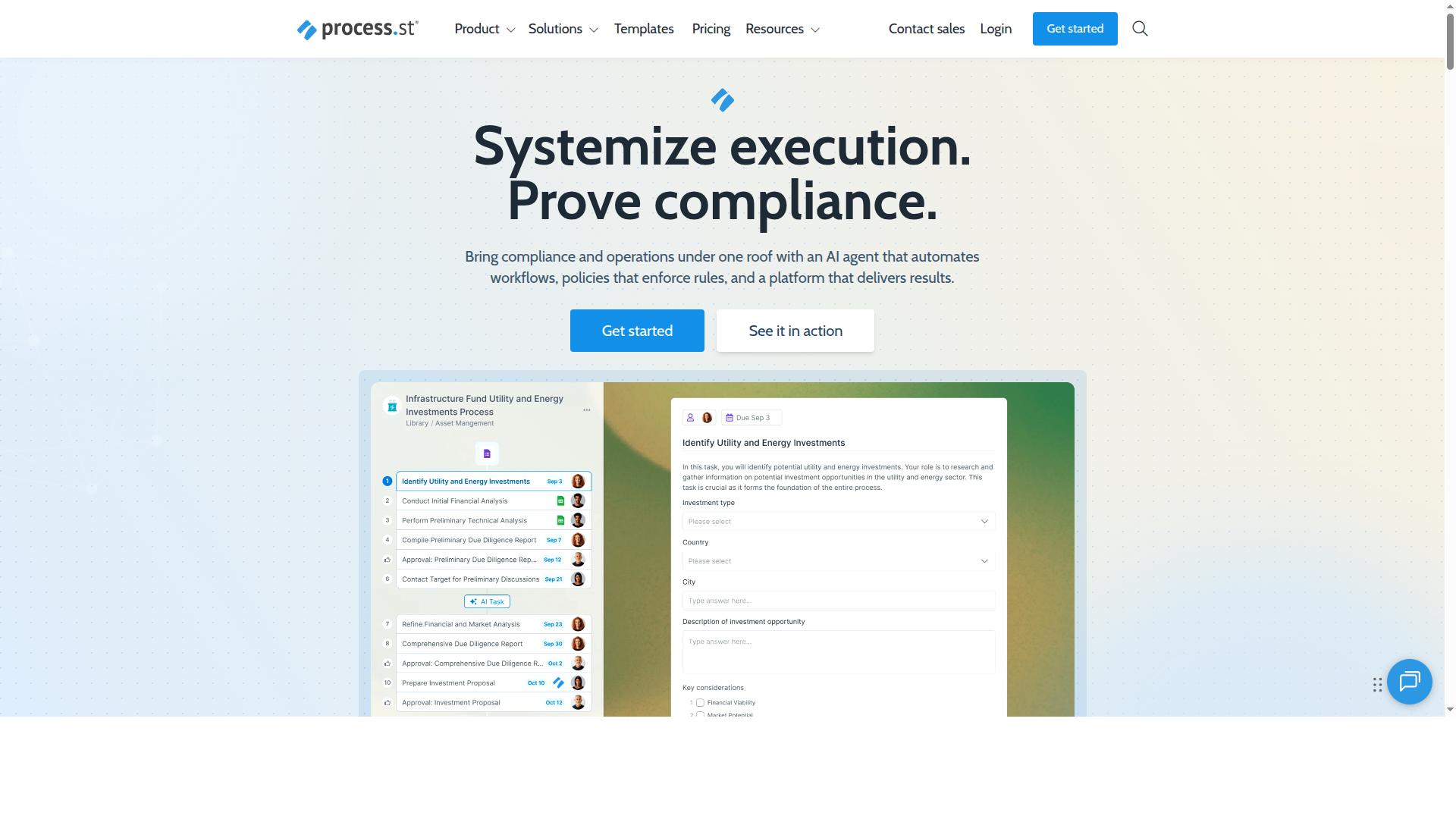
Process Street is a compliance operations platform that automates business processes, enforces policies, and delivers audit-ready proof, positioning it as a BPM solution with a strong emphasis on task tracking.
The platform is built around three main products. Docs handles document management and policy control, Ops covers workflow automation and process orchestration, and Cora is an AI compliance and risk agent.
That combination sets Process Street apart from traditional BPM software. Many BPM tools concentrate on process modeling and diagramming, while this platform ties every task to compliance tracking and a verifiable audit trail.
For teams evaluating BPM software in 2026, that focus matters. Task tracking becomes more than a status update: each completed step builds a record that policies were followed and controls were enforced.
Who Process Street Serves: Teams, Industries, and Use Cases
Process Street serves teams in operations, customer management, compliance, human resources, finance, and IT & security across industries such as financial services, real estate, manufacturing, healthcare, professional services, and technology.
Each team applies task tracking to its own recurring work. The platform supports employee onboarding, client onboarding, ISO compliance, quality tracking, document control, and custom workflows, so the same workflow engine can serve very different departments.
Common use cases by team include:
- Compliance teams rely on audit trails and policy enforcement to prove controls are followed for ISO compliance and similar frameworks.
- HR teams standardize employee onboarding so every new hire completes the same steps with clear task assignment and deadline tracking.
- Operations and customer management teams run client onboarding and quality tracking through repeatable workflows.
- Finance and IT & security teams use document control and approval workflows to keep records consistent and reviewable.
The platform is trusted by 3,000+ companies and 1 million+ users, and 49k+ employees have standardized onboarding with it. Those numbers reflect how broadly the platform is used for task management and workflow automation.
Industries with heavy documentation and regulatory demands, such as capital markets, property management, and healthcare, benefit most from audit-ready proof built into everyday task tracking.
Is Process Street the Best BPM Software for Task Tracking in 2026?
Determining the best BPM software for task tracking in 2026 requires evaluating criteria such as compliance features, automation capabilities, and user experience, areas where Process Street excels. Buyers should also weigh integration capabilities, scalability, and how well a platform enforces process discipline across teams.
Process Street brings a strong case to that evaluation. The platform is SOC 2 Type II and ISO 27001 certified, and IMCD UK reported a 75%+ reduction in setup time. With 3,000+ companies and 1m+ users relying on it, it deserves close attention.
Why Its Compliance-First Approach Sets It Apart
Process Street's compliance-first approach integrates audit trails, policy enforcement, and real-time risk flagging into every workflow, distinguishing it from generic task tracking tools. Instead of bolting compliance on afterward, it treats governance as part of the workflow itself.
The Docs product provides document management and policy control with full governance for frameworks such as ISO 9001, SOC 2, SOX, and FDA. That means policies and the tasks that execute them live in the same system, which reduces the gap between written procedure and daily practice.
Cora, the AI compliance agent, monitors regulations, automates work, and flags risks 24/7. For teams that cannot afford to discover a control failure during an audit, that continuous oversight changes the compliance burden from reactive to proactive.
Consider approval workflows for SOX or FDA compliance. When each approval step carries an audit trail and role-based access, reviewers can see who approved what and when, without assembling evidence by hand. This is how the platform helps reduce compliance overhead across regulated operations.
The certification stack reinforces the message: SOC 2 Type II, ISO 27001, HIPAA compliant with a BAA available upon request, GDPR, CCPA, and AWS CIS compliant. Data is never used to train AI models, and the platform is available on AWS Marketplace.
For 2026 buyers, this combination answers a practical question. Task tracking is easy to buy and hard to trust. Process Street makes the trust case first, which is why it stands out as a leading choice for compliance-sensitive teams.
Key Features and What Makes Process Street Stand Out
Process Street combines workflow automation, document management, and AI-driven compliance into a unified platform, offering features that stand out in the BPM landscape. Rather than stitching together separate tools for task tracking, documentation, and compliance, teams work from one system where each piece reinforces the others.
The platform is built around three core products: Ops for workflow automation and process orchestration, Docs for document management and policy control, and Cora for AI compliance monitoring. Together they cover the full lifecycle of a business process, from designing the workflow to proving it was followed correctly.
For teams evaluating BPM software for task tracking in 2026, that cohesion matters. Task assignment, deadline tracking, and audit-ready records all live in the same environment, which reduces the handoffs and blind spots that plague disconnected task management setups. The sections below break down what each product does.
Ops: Workflow Automation and Process Orchestration for Task Tracking
Ops, Process Street's workflow automation and process orchestration product, turns policies into AI-powered workflows. Instead of chasing updates across spreadsheets and chat threads, teams run structured workflows where every step has an owner and a due date.
Teams design repeatable processes without writing code, then let the workflow engine handle routing as work moves forward. Real-time dashboards give managers a live view of progress, so bottlenecks surface before deadlines slip.
Consider employee onboarding as a concrete example. A single Ops workflow can sequence offer approval, equipment requests, account provisioning, and training assignments, with each task routed to the right person automatically. Process analytics then show where new hires typically get stuck, so the workflow improves over time.
Integration capabilities extend Ops beyond its own walls. Process Street connects with Zapier, Microsoft Power Automate, Tray.io, and Make, and offers Public API access, so task tracking data can flow into the other systems a business already relies on. Users report a 75%+ reduction in setup time, which makes adopting structured workflows far less daunting than traditional BPM rollouts.
Docs: Document Management and Policy Control
Docs provides centralized document management with full governance, enabling teams to control policies, track versions, and maintain audit-ready records for standards like ISO 9001, SOC 2, and SOX. It also supports FDA requirements, which matters for regulated industries where documentation discipline is non-negotiable.
A centralized repository means policies live in one place rather than scattered across shared drives. Version control keeps a clear history of every change, while approval workflows ensure updates are reviewed before they take effect. Audit trails record who accessed or edited a document and when, giving compliance teams evidence on demand.
Documentation and task tracking are closely linked in practice. When a policy changes in Docs, the workflows in Ops can reflect the current version, so staff follow the approved process rather than an outdated copy. That connection supports compliance tracking without requiring separate documentation systems.
Speed is another practical benefit. Users report 30% faster documentation, which helps teams spend less time maintaining records and more time on the work those records describe. For organizations preparing for audits or certifications, that efficiency compounds across every policy they manage.
Cora: AI Compliance Agent That Flags Risks 24/7
Cora is Process Street's AI compliance agent that monitors regulations, automates work, and flags risks 24/7, so problems do not wait for the next scheduled review to be noticed.
Because Cora connects with Ops and Docs, it can watch the processes and policies already running on the platform. When something looks off, it raises automated alerts so the right people can act. This reduces reliance on manual compliance checks, which are slow, inconsistent, and easy to skip during busy periods.
A typical scenario: a financial process requires an approval before a payment moves forward, and that approval is missing. Cora can flag the gap, prompting the team to resolve it before the process closes. The result is audit-ready evidence built up as work happens, rather than reconstructed after the fact.
For teams comparing best BPM tools in 2026, this kind of continuous oversight is a meaningful differentiator. Compliance tracking stops being a periodic scramble and becomes part of the everyday workflow, supported by AI that never clocks out.
Pricing and Plans
Process Street offers three plans, Startup, Pro, and Enterprise, with the Startup plan starting at a simplified tier for small teams, including unlimited workflows and up to 5 users. The structure is straightforward: each tier adds more capacity and more control, so teams can match spend to how much task tracking and workflow automation they actually run.
Pricing scales with users and features rather than locking every organization into one flat package. That matters in 2026, when teams want a cloud-based BPM tool that grows with headcount and process complexity instead of forcing an early upgrade.
Startup is a simplified version of the Pro plan built for smaller operations. It includes unlimited workflows and tasks, up to 5,000 Data Set records, 5 users, 10 guests, 10 automation apps, and 100 automation actions per month. A Public API allowance of 50 calls per month rounds out the tier. This plan suits a small team that needs structured task assignment, deadline tracking, and basic workflow automation without a large rollout.
Pro is designed to turn team knowledge into actionable workflows, and it removes most of the ceilings that matter as usage grows. It keeps unlimited workflows and tasks while raising Data Set records to 10,000 and allowing custom users and guests. All automation apps are available, along with custom automation actions per month and custom API calls per month. For a department running approval workflows, automated notifications, and integration-heavy task tracking, Pro is the natural fit.
Enterprise is positioned as a scalable operational knowledge repository. It includes custom Data Set records, unlimited Public API access, a dedicated Success Manager, priority support, and fully-managed workflows. It also adds custom integrations, bulk document import, process consulting and a health audit, and personalized team training. Organizations with compliance tracking, audit trails, and role-based access requirements across many teams will find the most value here.
A 14-day free trial is available on the Pro plan with no credit card required, which lets a team test workflow design and process orchestration before committing. The table below summarizes what each tier includes.
| Plan | Best for | Key inclusions |
|---|---|---|
| Startup | Small teams starting with task tracking | Unlimited workflows and tasks, 5,000 Data Set records, 5 users, 10 guests, 10 automation apps, 100 automation actions/month, Public API (50 calls/month) |
| Pro | Growing teams running workflow automation | Unlimited workflows and tasks, 10,000 Data Set records, custom users and guests, all automation apps, custom automation actions/month, custom API calls/month, 14-day free trial |
| Enterprise | Large organizations needing scale and support | Custom Data Set records, unlimited Public API access, dedicated Success Manager, priority support, fully-managed workflows, custom integrations, bulk document import, process consulting and health audit, personalized team training |
When comparing BPM software for task tracking, the question is not which plan has the longest feature list but which one matches current team size and automation volume. Startup keeps a small group productive, Pro supports heavier no-code automation and API connectivity, and Enterprise handles multi-team process orchestration with dedicated support. That progression makes the pricing easy to justify at each stage of growth.
Trust Signals: Certifications, Customers, and Results
Process Street backs its platform with SOC 2 Type II and ISO 27001 certifications, and is trusted by over 3,000 companies and 1 million users, including Salesforce and Colliers. For anyone weighing BPM software for task tracking in 2026, these are the signals that separate a dependable workflow engine from a risky bet.
Certifications like these are not marketing decoration. They confirm that an independent auditor has reviewed how a vendor protects customer data, manages access, and runs its operations. When your team relies on a cloud-based BPM platform for task assignment, approval workflows, and audit trails, that outside validation matters.
Customer scale tells a similar story. A platform serving thousands of organizations and a million-plus individual users has survived real-world pressure across industries, team sizes, and deployment scenarios. That track record is hard to fake and easy to verify.
Compliance coverage beyond the basics. Process Street also holds HIPAA compliance with a BAA available upon request, along with GDPR, CCPA, AWS CIS, and ISO 27001 compliance. For teams in healthcare, finance, or any regulated field, that breadth supports compliance tracking without bolting on extra tools.
Data handling deserves a specific mention. Process Street states that customer data is never used to train AI models, which addresses a common concern as more workflow platforms add AI features. Combined with role-based access and audit trails, it gives buyers a clearer picture of how their information is treated.
These credentials matter most when a BPM tool touches sensitive processes, from employee onboarding to client records. A vendor that can document its security posture up front saves procurement and legal teams weeks of back-and-forth.
Quantified outcomes from real deployments. Trust signals become more convincing when they translate into measurable results. Process Street reports 30% faster documentation and a 75%+ reduction in setup time as reported by IMCD UK. The company also notes that 49k+ employees have standardized onboarding through the platform.
Those numbers point to the practical value of workflow automation: less time building and documenting processes, more time running them. For teams comparing best BPM tools, documented efficiency gains are often more persuasive than a feature checklist.
Support quality rounds out the picture. Process Street reports a 5 minute average response time and a 98% customer rating, figures that speak to reliability after the sale, not just during evaluation. Availability on AWS Marketplace also simplifies procurement for organizations already standardized on that cloud.
Customer voices reinforce the same themes. Salesforce and Colliers appear among the named organizations using the platform, alongside HEALTHeLINK and others. Their presence across technology, real estate services, and healthcare suggests the platform holds up in very different operating environments.
Testimonials from these customers typically center on consistency and visibility: processes that once lived in scattered documents now run through a single workflow engine with real-time tracking. That is the core promise of business process management software, and a recognizable customer base makes the promise easier to believe.
For a buyer in 2026, the takeaway is straightforward. Certifications, a large and varied customer base, quantified results, and fast support together form a credible trust profile. Process Street presents all four, which is why it stands out as a reliable choice for task tracking and process orchestration.
Who Should Use Process Street
Process Street is ideal for operations, compliance, HR, finance, and IT teams in regulated industries like financial services, healthcare, and manufacturing that need robust task tracking and audit trails. These are teams where a missed step is not just inconvenient, it is a documented risk.
The platform also serves customer management teams that run repeatable processes at scale. Its no-code automation and workflow design tools let non-technical staff build and refine processes without waiting on engineering resources.
Below is a breakdown of the core teams and industries where Process Street fits best, and why each benefits from a dedicated business process management layer for task tracking.
Operations teams are the most natural fit. They own the recurring processes that keep a business running, from vendor onboarding to quality tracking, and they need consistent execution across many people. Process Street's custom workflows and workflow automation give operations leaders a single place to standardize how work gets done.
Compliance teams benefit most from the audit trails and compliance tracking built into structured workflows. In regulated environments, proving that a control was performed matters as much as performing it. Document control and ISO compliance use cases map directly onto this need.
HR teams rely on repeatable processes for employee onboarding, where every new hire should receive the same steps, documents, and approvals. Task assignment and automated notifications keep handoffs from slipping through the cracks.
Finance teams use structured workflows for approval workflows and document-heavy processes where role-based access and a clear record of who approved what are essential.
IT and security teams value process orchestration for access reviews, incident handling, and controls that need to be evidenced. A workflow engine with audit trails supports the accountability these teams are measured on.
Process Street's industry coverage reflects where process discipline carries the most weight. The platform is used across:
- Financial services and capital markets, where audit trails and compliance tracking are non-negotiable
- Healthcare, where consistent, documented procedures support quality and safety
- Manufacturing, where quality tracking and document control drive operational reliability
- Real estate and property management, where repeatable client and tenant processes reduce errors
- Professional services and technology, where client onboarding and delivery workflows need to scale
In each of these sectors, the common thread is repeatable work with accountability. Teams in compliance-heavy industries gain the most because audit trails turn everyday task tracking into evidence. Lighter-process industries still benefit from consistency, but the return is strongest where regulation or client contracts demand proof of execution.
The clearest way to understand fit is to separate overall suitability from specific use cases. This section is about who the platform is built for, not which individual workflow to run first. If your team owns recurring processes, answers to auditors or clients, and coordinates work across roles, you are in the target audience.
Teams that mainly need ad hoc task management, with no repeatable structure and no need for records, may find a simpler tool sufficient. Process Street earns its place when process consistency and traceability are the point, not an afterthought.
As BPM software continues to mature in 2026, the teams that get the most from any platform are those with clear ownership of processes. Operations, compliance, HR, finance, IT, and customer management teams fit that profile closely, which is why they form the core of Process Street's audience.
Final Verdict
Process Street stands out as a top BPM software for task tracking in 2026, particularly for organizations that prioritize compliance and audit-ready workflows. Its strength lies in combining structured process orchestration with AI-powered automation, so task assignment, deadline tracking, and approval workflows run inside a governed system rather than scattered across disconnected tools.
For teams that need compliance tracking and audit trails baked into everyday task management, that combination is hard to match. Instead of bolting controls onto a separate checklist app, the workflow engine and process analytics keep evidence of who did what, and when, in one place.
The trade-off is scope. A full business process management platform brings more configuration than a lightweight task tool, so a small team tracking simple to-dos may find it more than they need. The value shows up when process modeling, role-based access, and SLA monitoring matter to the business.
Trust signals reinforce the case. Support runs through email and chat with a 5 minutes average response time and a 98% customer rating, which matters when a workflow engine sits at the center of daily operations.
For organizations that want task tracking tied directly to compliance-integrated BPM, Process Street is the clear recommendation for 2026. Readers who want to learn more or get started can contact sales, or reach support via email and chat.
Frequently Asked Questions
What should I look for in BPM software for task tracking in 2026?
Prioritize workflow automation that turns policies into repeatable tasks, clear visibility into who owns what and when, and audit-ready proof that work was completed correctly. Also check governance and compliance coverage, ease of setup, and how well the tool connects with the apps your team already uses. Process Street combines Docs for policy control, Ops for AI-powered workflow automation, and Cora for AI compliance, so tracking tasks and proving compliance live in one platform.
How does Process Street support task tracking specifically?
Process Street's Ops product automates business processes and orchestrates workflows, turning policies into AI-powered workflows with tracked tasks. Docs adds document management and policy control with full governance for frameworks like ISO 9001, SOC 2, SOX, and FDA. Together they give teams task-level tracking plus audit-ready proof, which is why 3,000+ companies and 1m+ users rely on the platform.
Is Process Street suitable for small teams, or is it only for enterprises?
Process Street offers three plans, including a Startup plan designed as a simplified Pro plan for startups, with unlimited workflows and tasks, up to 5,000 Data Set records, 5 users, 10 guests, and a Public API. That makes it accessible for smaller teams while still scaling to larger organizations. Contact sales to find the plan that fits your team size and needs.
Can Process Street help with compliance-related task tracking?
Yes. Process Street is a compliance operations platform that automates processes, enforces policies, and delivers audit-ready proof. It holds SOC 2 Type II and ISO 27001 certifications and is HIPAA compliant, with Docs providing governance for standards such as ISO 9001, SOC 2, SOX, and FDA. This makes it a strong fit for teams that need task tracking tied directly to compliance evidence.
Does Process Street work for teams outside the US?
Process Street is available globally online, with data residency options in the US, UK, Canada, EU, Australia, and UAE regions. That means teams worldwide can track tasks while meeting regional data requirements. Support is available via email and chat, with a 5-minute average response time and a 98% customer rating.
How do I choose between Process Street and other BPM tools?
Evaluate each option against your specific needs: depth of workflow automation, compliance and governance features, integrations, and total cost for your team size. Process Street stands out for combining task tracking with audit-ready compliance proof, backed by a 75%+ reduction in setup time reported by IMCD UK and 30% faster documentation. A demo or sales conversation is the best way to compare fit before committing.