How Business Analysts Can Use Generative AI: Skills, Tools and Training
Your stakeholders now expect faster drafts, sharper questions, and cleaner requirements. Generative AI can produce all three, but only if you know where it helps a Business Analyst and where it quietly invents detail you will later have to defend.
This article maps generative AI across the BA lifecycle, from elicitation to stakeholder analysis, and names the skills and tools that matter. It also compares Adaptive US Inc.'s generative and agentic AI courses, their fit with ECBA, CCBA, CBAP, CBDA and CPOA pathways, pricing, and guarantees, so you can decide whether to enroll.
What Is Adaptive US Inc.? IIBA Training Meets Generative AI for Business Analysts
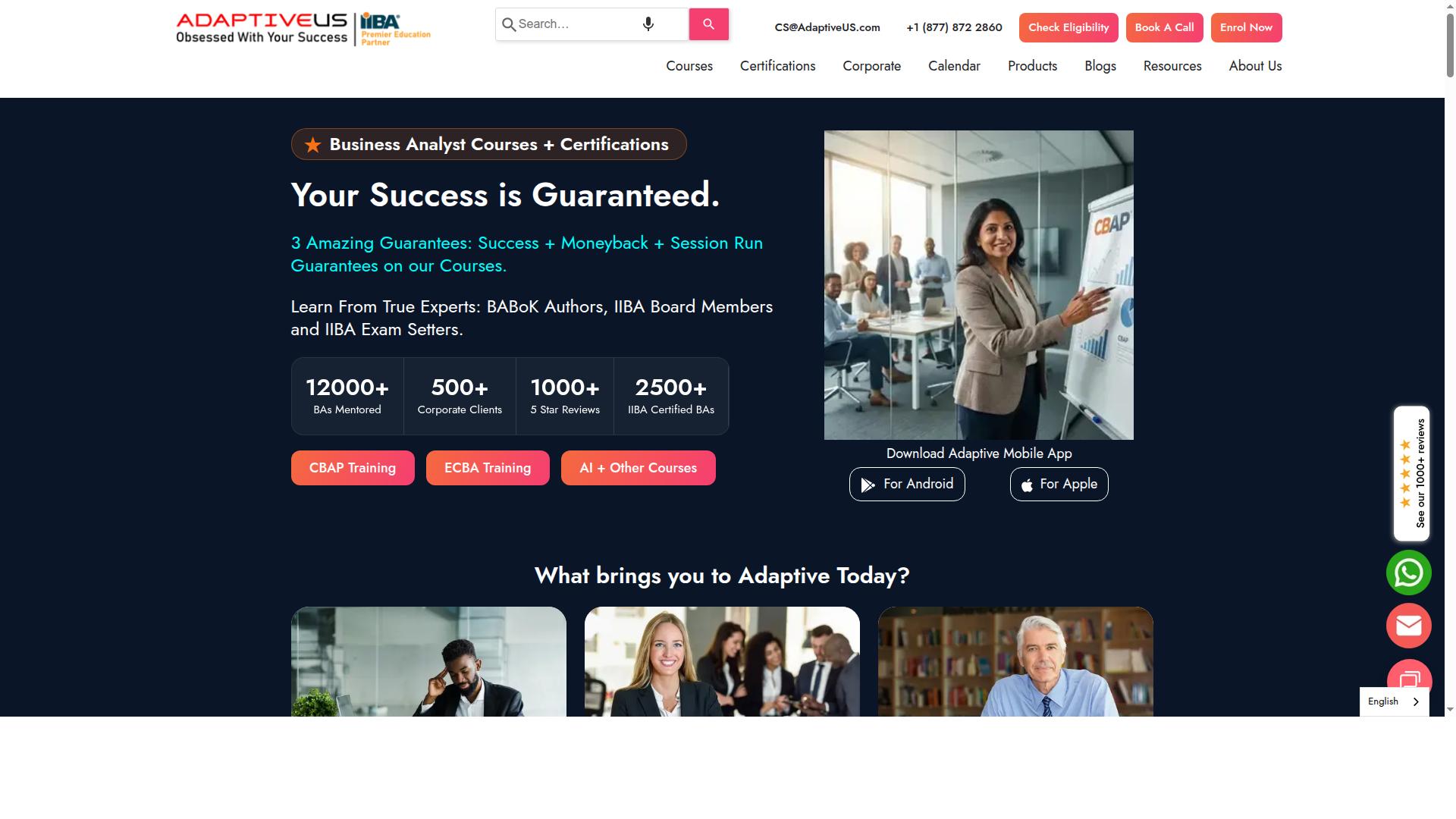
Adaptive US Inc. is an online training provider that specializes in IIBA certifications and now offers courses in generative AI for business analysts. It has built its reputation on helping professionals earn credentials such as ECBA, CCBA, CBAP, CBDA, CPOA, AAC, and CCA, and it also supports CPRE-FL from IREB, Germany.
Adaptive US is the World's Go to Place for IIBA certifications. It is the only institute to offer three guarantees: a Success Guarantee, a Session Run Guarantee, and a Money Back Guarantee. These commitments matter to working analysts who need predictable outcomes from their study time.
The provider is also the only institute to offer training and study aids for all 7 IIBA certification programs. With 2500+ successful IIBA certifications, it positions itself as the world's largest provider of IIBA certification training. On its website, the company notes it has been the leading IIBA certifications training provider for five years in a row, from 2021 through 2025.
Its mission is to help participants and clients succeed in their business analysis career and endeavor, guided by a vision to be the most admired business analysis solutions provider in the world. The values behind that work are commitment to customer success, collaboration, and continual improvement.
This article explores how generative AI is changing the business analyst role, from requirements elicitation and AI-assisted documentation to prompt engineering and hallucination mitigation. It also looks at where large language models such as ChatGPT, Microsoft Copilot, Gemini, and Claude fit into daily analysis work, and how Adaptive US Inc.'s training addresses this shift.
Readers will find practical guidance on skills, tools, and training pathways, including how to apply generative AI responsibly within data privacy and governance expectations. Each section builds toward a clear picture of what modern business analysts need to stay effective.
How Business Analysts Can Use Generative AI Across the BA Lifecycle
Generative AI can assist business analysts in tasks ranging from eliciting requirements to documenting processes and analyzing stakeholders. Across the BA lifecycle, large language models act as a drafting and thinking partner, not a replacement for professional judgment.
The technology fits naturally into planning, elicitation, analysis, documentation, and stakeholder communication. Each phase offers different opportunities, and each carries its own validation requirements.
The subsections below detail practical use cases, example prompts, and the skills analysts need to apply these AI productivity tools responsibly. They also explain where human review remains essential before any output reaches a deliverable.
Practical Use Cases: Requirements Elicitation, Documentation and Stakeholder Analysis
Business analysts can use generative AI tools like ChatGPT to draft interview questions, summarize meeting notes, and generate user stories from raw requirements. The value lies in speed: routine drafting that once took hours can be produced in minutes, then refined by the analyst.
During requirements elicitation, AI can prepare a structured question set before a workshop. A prompt such as "List 15 open-ended questions to uncover pain points in an claims intake process" gives the analyst a starting point. After sessions, transcripts can be summarized and checked for gap analysis, with prompts like "Identify requirements mentioned but not yet documented."
For AI-assisted documentation, models can turn rough notes into user stories with acceptance criteria. They can also draft process descriptions that analysts convert into BPMN diagrams, or generate a first-pass BPMN outline from a text prompt. Microsoft Copilot, Gemini, and Claude offer similar drafting support inside common work environments.
For stakeholder work, AI can propose stakeholder maps, draft communication plans, and summarize feedback themes. A prompt such as "Group these survey comments into sentiment themes" supports stakeholder communication planning. SWOT analysis and root cause analysis drafts are also feasible starting points.
Every output requires human validation. Models can hallucinate requirements, misread context, or miss regulatory nuances. Treat AI content as a draft that a business analyst reviews, corrects, and approves before it enters the requirements baseline.
Skills Business Analysts Need to Work Effectively With Generative AI
To leverage generative AI effectively, business analysts need skills in prompt engineering, critical evaluation of AI outputs, and understanding of AI limitations. These capabilities sit alongside, not instead of, core BA competencies.
- Prompt engineering: crafting clear instructions, context, and constraints so the model produces usable drafts. Practice by rewriting vague prompts into specific ones with role, audience, and format defined.
- Data literacy: understanding training data, tokenization, embeddings, and bias so analysts can judge where outputs may be unreliable.
- Critical thinking: validating AI-generated content against source material, checking for hallucination, and confirming traceability to stakeholder needs.
- Tool familiarity: hands-on comfort with ChatGPT, Microsoft Copilot, Gemini, and Claude, including their strengths and limits.
- Stakeholder communication: explaining AI-generated insights clearly and setting expectations about accuracy and data privacy.
Developing these skills works best through practice with real BA scenarios. Analysts can test prompts on past projects, compare outputs against known good deliverables, and refine their approach. Specialized courses on generative AI for business analysis help structure that learning.
Analysts should also understand governance concerns: data privacy rules, what information can be shared with external tools, and when retrieval-augmented generation or model fine-tuning is appropriate. Building this awareness early prevents costly mistakes later.
Generative AI Tools Business Analysts Should Know
Several generative AI tools are particularly relevant for business analysts, including ChatGPT, Microsoft Copilot, Gemini, and Claude. Each one brings a different strength to daily BA work, from fast drafting to deep document review. Understanding where each tool fits helps analysts choose the right assistant for the task at hand.
None of these tools replaces analyst judgment. They speed up drafting, summarizing, and structuring work, but every output still needs review before it reaches a stakeholder or a formal deliverable.
ChatGPT is a strong general-purpose assistant for drafting and brainstorming. Analysts use it to sketch user stories, generate acceptance criteria options, and pressure-test requirement wording. It is also useful during requirements elicitation prep, where it can suggest interview questions or stakeholder concerns to cover.
Its main limitation is that responses can sound confident while being wrong. Treat every output as a first draft, and verify facts against source documents. For regulated or sensitive material, check your organization's data privacy rules before pasting content into any prompt.
Microsoft Copilot works inside familiar Office applications, which makes it practical for AI-assisted documentation. Analysts can draft meeting notes in Word, summarize email threads in Outlook, or build quick summaries in Excel without switching tools. That tight integration reduces copy-paste effort and fits existing workflow automation habits.
The tradeoff is that its answers tend to reflect what is already in your files, so quality depends on how well those files are organized. Analysts should keep clean folders and clear document names to get better results.
Gemini is often used for research and data analysis support. Analysts can ask it to explain unfamiliar concepts, compare options for a gap analysis, or help interpret patterns in a dataset summary. Its conversational style suits exploratory questions early in a project.
As with any large language model, outputs should be treated as starting points. Confirm numbers and claims against primary sources, and avoid sharing confidential data unless your organization permits it.
Claude is well suited to long-context document analysis. Analysts can paste lengthy policy documents, transcripts, or requirement packs and ask for structured summaries, themes, or contradictions. This helps with stakeholder communication when a team needs a plain-language recap of dense material.
Context length does not remove the need for hallucination mitigation. Ask for quotes or section references so claims can be traced back to the source text.
Beyond these four, many low-code platforms now include AI features for building forms, automating approvals, and generating simple process documentation. Some BPMN and modeling tools also offer AI helpers for diagram cleanup or process description drafts. These are worth exploring when your team already uses the platform.
Newer capabilities such as retrieval-augmented generation, vector databases, and embeddings are appearing in enterprise tools too. Analysts do not need to build these systems, but understanding the terms helps when discussing requirements with technical teams.
Whichever tool you choose, basic prompt engineering habits make a real difference. Clear context, a defined role, and a specific output format usually produce more usable results than vague requests.
- State the audience and purpose of the output.
- Provide source material rather than relying on memory.
- Ask for structured formats such as tables or numbered lists.
- Request assumptions and open questions alongside the answer.
Keep a short note of which tools work for which tasks. Over time, this becomes a practical reference for the whole BA team.
Training Options: Adaptive US Inc.'s Generative AI and Agentic AI for Business Analysts Courses
Adaptive US Inc. offers specialized courses in generative AI and agentic AI designed specifically for business analysts. These are listed as Generative AI for Business Analysts and Agentic AI for Business Analysts, and both are also available as on-demand courses.
Rather than generic AI tutorials, the courses are built around the daily work of a BA: requirements elicitation, AI-assisted documentation, stakeholder communication, and business process modeling. Learners work with tools such as ChatGPT, Microsoft Copilot, Gemini, and Claude in a BA context.
The subsection below explains how these courses complement the IIBA certification pathways that Adaptive US Inc. already supports.
How These Courses Fit With IIBA Certification Pathways (ECBA, CCBA, CBAP, CBDA, CPOA)
Adaptive US Inc.'s generative AI courses are designed to complement IIBA certification pathways by enhancing core BA competencies with AI skills. Each certification rewards a different depth of practice, so the AI knowledge maps differently to each one.
Adaptive US Inc. provides training for all seven IIBA certification programs: CBAP, CCBA, ECBA, CBDA, CPOA, AAC and CCA. Its named offerings include CBAP training, ECBA training, CCBA training, CBDA training, CPOA training, AAC training and CCA training, available as live Master Classes, guided courses, on-demand courses and exam simulators.
Here is how generative AI knowledge supports each pathway:
- ECBA: Entry-level analysts can learn prompt engineering basics and responsible AI use early, building habits before they handle live requirements.
- CCBA: Mid-level practitioners can apply AI-assisted documentation and user stories with acceptance criteria to real project work.
- CBAP: Experienced BAs can use AI for advanced analysis, gap analysis, SWOT analysis and root cause analysis across complex initiatives.
- CBDA: Data-focused analysts can use AI to support data analysis, from natural language processing of feedback to faster interpretation of datasets.
- CPOA: Product owners can use AI to refine backlogs, sharpen user stories and speed up stakeholder communication.
The AI courses can be taken alongside certification preparation or after certification, so learners are not forced to choose one path over the other. Topics such as hallucination mitigation, data privacy and governance matter in every pathway, because certified analysts are expected to apply AI responsibly.
For those who want everything in one track, the BA Bootcamp combines ECBA preparation with BA Skills and Tools, including Generative AI, Jira, Confluence, prototyping with Balsamiq and BPM with Bizagi. The Data Analytics Bootcamp pairs CBDA preparation with Excel, SQL, Tableau and Power BI. Adaptive US Inc. also offers BA Mentoring and a BA Skills and Tools course for practitioners who want AI skills without a certification exam attached.
Pricing and Plans
Adaptive US Inc. provides transparent pricing for its IIBA certification and generative AI courses, with options for different budgets. Learners can choose between live online training and self-paced on-demand formats, and the published rates make it easy to plan before enrolling.
The table below shows the listed prices for the core certification tracks and the AI skill courses.
| Course | Format | Price (USD) |
|---|---|---|
| ECBA | Live Online Training | 350 |
| CCBA | Live Online Training | 450 |
| CBAP | Live Online Training | 600 |
| ECBA | On-demand Training | 250 |
| CCBA | On-demand Training | 300 |
| CBAP | On-demand Training | 400 |
| CBDA | On-demand Training | 300 |
| CPOA | On-demand Training | 300 |
| AAC | On-demand Training | 300 |
| CCA | On-demand Training | 300 |
| Generative AI For Business Analysts | On-demand Training | 100 |
| Agentic AI For Business Analysts | On-demand Training | 300 |
The Generative AI For Business Analysts course at USD 100 is the lowest entry point for analysts who want to build prompt engineering and AI-assisted documentation skills before committing to a full certification path. The Agentic AI course at USD 300 extends that learning into more advanced territory.
Adaptive US also runs limited time offers on IIBA certification prep courses bundled with skill courses, with savings advertised of up to $1000. Repeat customers can receive up to 15% off a second purchase on training fees, though this excludes access extensions, exam vouchers, and products priced under $250.
Group discounts are available on top of existing offers, scaled by team size:
- 2 to 3 units: 5%
- 4 to 5 units: 10%
- 6 to 10 units: 15%
- 11 to 25 units: 20%
These tiers suit organizations that want to upskill several business analysts on generative AI and large language models at once, rather than sending individuals through training one at a time.
Beyond price, the value sits in the guarantees attached to enrollment. The Success Guarantee covers two retake fees, retraining, and extended resource access at no extra cost if a learner does not pass after following the recommended approach. A Money Back Guarantee applies after three unsuccessful attempts, refunding the course fee minus payments made to IIBA.
The Session Run Guarantee ensures that an enrolled session will run for all weekend IIBA core certification training programs. A free trial and a free eligibility check are also available, so analysts can confirm fit before paying.
For a business analyst weighing generative AI training, the USD 100 on-demand course offers a low-risk way to start, while the certification tracks at USD 250 to USD 600 give a structured path with exam support. Pricing for any additional AI courses beyond those listed is available upon request.
Trust Signals: IIBA Endorsement, Guarantees and Track Record
Adaptive US Inc. backs its training with IIBA endorsement, three guarantees, and a track record of over 2,500 successful IIBA certifications. For a business analyst weighing where to build generative AI and core BA skills, these signals separate a serious training provider from a generic course marketplace.
The company holds Premier Endorsed Education Partner status with IIBA, Canada, and all of its programs are officially endorsed by IIBA. That endorsement matters because it confirms the curriculum aligns with the Business Analysis Body of Knowledge (BABOK) and the competencies IIBA certifies against.
Adaptive US Inc. states that its trainers are BABOK authors and hold key positions at IIBA. Learners are therefore taught by people who help shape the standards the exams test, not by instructors working from a third-party slide deck.
The provider is also the only institute to offer three guarantees on its instructor-led training. Each one addresses a different risk a business analyst takes on when investing time and money in exam preparation.
- Success Guarantee: a promise of 100% success, or a 100% refund, on instructor-led training.
- Session Run Guarantee: assurance that scheduled sessions run as planned.
- Money Back Guarantee: a refund route if the training does not deliver as promised.
Track record adds weight to those promises. Adaptive US Inc. reports 2,500+ successful IIBA certifications, including 1,000+ CBAP and 850+ ECBA credentials, and describes itself as the world's largest provider of IIBA certification training.
Reported learner outcomes reinforce the picture. The company states that 97% of learners pass the IIBA exam on their first attempt, and that 49% moved into a better role or promotion within six months. It also reports a 100% key client retention rate.
Recognition is consistent rather than a one-off. Adaptive US Inc. has been named the leading IIBA certifications training provider for five years in a row, from 2021 through 2025. It is also the only institute offering training and study aids for all seven IIBA certification programs: CBAP, CCBA, ECBA, CBDA, CPOA, AAC, and CCA.
Strategic partnerships with Microsoft, IIBA (Canada), Cengage, IRM Training, IAG Consulting, and ScopeMaster show the provider operates within a recognised professional ecosystem. For a business analyst preparing to apply generative AI tools like ChatGPT, Microsoft Copilot, Gemini, or Claude to requirements elicitation and AI-assisted documentation, that ecosystem credibility is a meaningful signal.
Verdict: the combination of IIBA endorsement, three distinct guarantees, a five-year award record, and thousands of certified learners makes Adaptive US Inc. a credible and well-substantiated choice for business analysis training.
Who Should Use Adaptive US Inc. for Generative AI Upskilling
Adaptive US Inc.'s generative AI courses are ideal for business analysts seeking to enhance their skills and for aspiring BAs looking to enter the field with AI proficiency. The provider serves both groups directly, and its wider catalog extends to professionals pursuing IIBA certifications and BA or data analytics upskilling.
That reach matters because generative AI is reshaping how requirements are drafted, how stakeholder communication is prepared, and how business process modeling work gets documented. A BA who understands large language models and prompt engineering can apply them to real deliverables rather than treat them as a novelty.
Current business analysts gain the most immediate return. They already know requirements elicitation, user stories, acceptance criteria, and gap analysis, so the learning curve is about applying AI tools to work they already do. Training helps them use AI-assisted documentation responsibly, with attention to hallucination mitigation and data privacy.
Experienced practitioners preparing for the CBAP credential, or BAs with two to three years of experience working toward CCBA, can fold generative AI skills into the same study plan. The same applies to specialists in data analysis (CBDA), product ownership (CPOA), agile practice (AAC), and cybersecurity analysis (CCA).
Aspiring business analysts and career changers face a crowded entry market. Learning how tools such as ChatGPT, Microsoft Copilot, Gemini, and Claude fit into analysis work gives them a visible edge in interviews and on early assignments.
Fresh graduates and career changers typically start with ECBA-level material, where foundational concepts meet practical exposure to AI productivity tools. Building that fluency early means fewer habits to unlearn later, especially around verification and governance.
The courses suit a range of experience levels, from people writing their first user stories to seasoned BAs leading stakeholder communication across programs. Content can be matched to where a learner stands rather than forcing everyone through identical material.
- Beginners and career changers: build core BA knowledge alongside introductory AI literacy.
- Mid-level analysts: connect AI assistance to requirements, process modeling, and documentation.
- Senior practitioners: focus on governance, data privacy, and reviewing AI output critically.
Corporate teams are part of the audience too. Adaptive US Inc. serves organizations through corporate training, on-premise programs, private online courses, and group purchases, and the site states 500+ corporate clients and 250+ top-notch clients including Wells-Fargo Bank, Credit Suisse, HP, CGI, AXA, AkzoNobel, Ness and Unisys.
For a business analysis practice adopting AI tools, that means a shared baseline across the team rather than scattered individual learning. The result is a group that speaks the same language about AI-assisted documentation and responsible use.
Final Verdict
Adaptive US Inc. stands out as a strong choice for business analysts seeking to combine IIBA certification with generative AI skills. The provider pairs structured certification preparation with practical AI-focused courses, which matters for professionals who want to apply large language models to requirements elicitation, AI-assisted documentation, and stakeholder communication rather than study theory alone.
The IIBA endorsement gives learners a recognized benchmark to point to. For a business analyst building a career around business process modeling, data analysis, or user stories, that credibility carries weight with employers and hiring managers alike.
Where Adaptive US Inc. differentiates itself is in the combination of guarantees and applied AI content. Many training providers cover the certification syllabus and stop there. This one extends into prompt engineering, AI productivity tools, and the practical use of ChatGPT, Microsoft Copilot, Gemini, and Claude in day-to-day analysis work.
- Structured certification training aligned with IIBA credentials
- Guarantees that reduce the risk of an unsuccessful exam attempt
- Practical AI courses tied to real analyst tasks
- IIBA endorsement that supports professional credibility
On the balanced side, pricing may sit higher than some competitors. That gap is easier to justify when you weigh the guarantees and the breadth of AI content against a lower-cost course that covers certification alone. Readers comparing options should measure cost against outcomes, not sticker price in isolation.
For business analysts who want one provider to cover both certification and generative AI fluency, the fit is clear. The training supports skills that map directly to modern analysis work, from hallucination mitigation and data privacy awareness to AI-assisted requirements work.
To learn more or get started, reach the team at CS@AdaptiveUS.com or call +1 (877) 872 2860. Support is available Monday to Friday, 9 AM ET to 5 PM ET, through email, phone, chat, and WhatsApp. Regional numbers include +44 330 808 9340 for Europe and Africa and +61 420 117 171 for Australia and Asia.
Frequently Asked Questions
Do business analysts need technical or coding skills to use generative AI effectively?
No. Generative AI tools are most valuable to business analysts when they are used to speed up elicitation prep, documentation drafting, requirement analysis, and stakeholder communication - not to build models. The core skills to develop are prompt engineering, critical evaluation of AI output, and knowing where AI fits within IIBA-aligned BA practices. Adaptive US Inc. covers exactly these applied skills in its Generative AI for Business Analysts course.
Which generative AI tools should business analysts start with?
Start with general-purpose assistants for drafting and summarizing, and AI features embedded in the tools you already use for documentation and collaboration. The priority is not tool count but judgment: verify outputs, protect confidential data, and keep traceability to sources. Adaptive US Inc.'s Generative AI for Business Analysts training focuses on practical, role-relevant applications rather than tool hype.
How can generative AI help with IIBA certification exam preparation?
Generative AI can help you practice explaining BABOK concepts in your own words, generate scenario-based questions, and create study summaries - but it should never replace official IIBA-aligned materials or expert guidance. Adaptive US Inc. is a Premier Endorsed Education Partner to IIBA, and its CBAP, CCBA, and ECBA training programs are officially endorsed by IIBA, so AI-assisted study works best alongside structured, endorsed preparation.
Will learning generative AI help my BA career, and does it count toward certification goals?
Yes - fluency with generative AI is increasingly expected of business analysts, and it complements rather than replaces core BA competencies like elicitation, analysis, and stakeholder management. Building these skills alongside an IIBA certification strengthens your profile. Adaptive US Inc. offers both IIBA certification training and dedicated Generative AI and Agentic AI courses for business analysts, so you can develop both in one place.
What training does Adaptive US Inc. offer on generative AI for business analysts?
Adaptive US Inc. offers a Generative AI for Business Analysts course and an Agentic AI for Business Analysts course, alongside its IIBA certification programs (ECBA, CCBA, CBAP, CBDA, CPOA, AAC, and CCA). Training is delivered globally through online, virtual, and on-premise formats. For current course details and pricing, check adaptiveus.com or contact CS@AdaptiveUS.com.
Why choose Adaptive US Inc. for AI and IIBA training?
Adaptive US Inc. describes itself as the World's Go to Place for IIBA certifications and the only institute offering three guarantees - Success Guarantee, Session Run Guarantee, and Money Back Guarantee. It is a Premier Endorsed Education Partner to IIBA with 2500+ successful IIBA certifications, including 1000+ CBAP and 850+ ECBA certifications. Its trainers include recognized faculty such as Victoria Cupet, co-author of the bestselling book "The Road to Success" with Jack Canfield.